
Bain & Company Style Case: Phighting Phillies | Case Interview Practice
Practice with AI
Hone your skills by practicing this case with our AI-powered consultant.
Our client, Alpha Capital, is a private equity firm that is considering buying the Philadelphia Phillies. The current team owners approached Alpha about purchasing the team for $1.1B. Alpha engaged our firm in the due diligence process and wants us to help them understand whether to buy the team.
Alpha Capital is a private equity firm evaluating the acquisition of the Philadelphia Phillies MLB franchise. The current owners have approached Alpha with an asking price of $1.1 billion. Alpha has engaged consultants to support the due diligence process. This is a new standalone fund with no hold period constraints, no prior investments, and hurdle rates are not a binding constraint. The motivation is dual: maximize financial returns, and the fund's leadership are avid Phillies fans who want the team to win. The team does not own its stadium; the City of Philadelphia owns it and the team pays annual leasing costs. Spring training and the farm system are excluded from the analysis. The case has two core deliverables: arrive at a standalone valuation of the team, then assess whether the acquisition makes sense after accounting for synergies and qualitative considerations.
(read to candidate): Our client, Alpha Capital, is a private equity firm that is considering buying the Philadelphia Phillies. The current team owners approached Alpha about purchasing the team for $1.1 billion. Alpha has engaged our firm in the due diligence process and wants us to help them understand: A. What is the team worth? B. Should they make this investment? The two-part decision: Part A - Valuation: Build a revenue and cost model from first principles, then apply a discount rate to arrive at an intrinsic value. Part B - Investment Decision: Compare valuation to asking price, identify synergies that could bridge any gap, and assess qualitative risks before making a final recommendation. Interviewer note: Before revealing revenue and cost figures, ask the candidate to brainstorm revenue streams and cost drivers from scratch. This brainstorm is scored separately from the math.
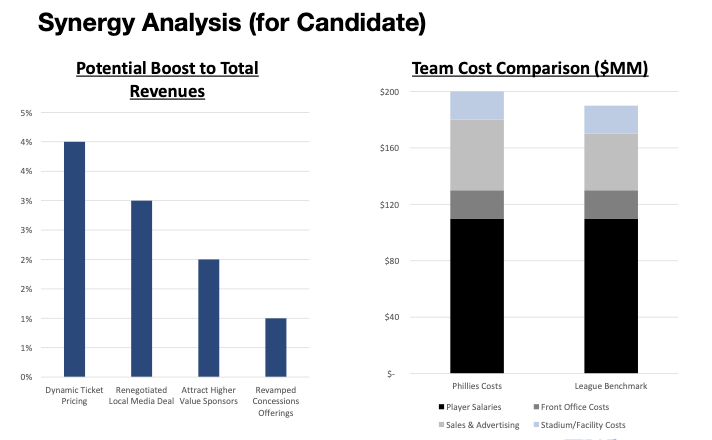
Framework This is a classic M&A/PE due diligence case with two sequential analyses. The candidate must first build a valuation from first principles - not apply a generic framework and then stress-test it with synergies and qualitative risks. Brainstorm Revenue & Costs → Build P&L → Arrive at Standalone Valuation → Compare to Asking Price → Identify Synergies → Revised Valuation → Qualitative Considerations → Recommendation The pivotal realization is that the deal only works with synergies. A candidate who stops at the standalone valuation and says "don't buy" misses the point entirely. A candidate who breezes past the gap without identifying synergies has the same problem. Standalone Valuation vs. Asking Price The standalone valuation of $1.0B falls $100M short of the $1.1B ask. This should prompt the candidate to hunt for upside and not walk away. Synergy-Adjusted Recommendation Recommendation: Alpha should proceed with the acquisition at $1.1B - conditional on execution of synergies. Three reasons: The deal is accretive with synergies. At a synergy-adjusted valuation of $1.4B, Alpha acquires the team at a $300M discount to intrinsic value. The $40M in annual synergies is well-supported by benchmarking data. The largest synergy (Sales & Advertising) is highly credible. The $10M cost gap vs. the league benchmark is specific and actionable - a PE firm with operational expertise is exactly the right buyer to close it. Revenue initiatives are realistic. Dynamic ticket pricing (already standard in other sports) alone contributes $12M annually. Combined with a renegotiated local media deal and a more structured sponsorship approach, the 10% total revenue uplift is achievable within 2–3 years. Risks to Flag Execution risk: Synergies are not guaranteed. If only 50% are captured, the valuation premium shrinks to ~$200M is still positive but with less cushion. Tension between ROI and winning: Cutting player salaries to maximize profit could alienate fans and erode the very revenue streams the model depends on. League approval and fan reaction: MLB controls who can own franchises; PE ownership is scrutinized. Fanbase trust must be managed carefully to protect ticket and sponsorship revenues. Macro baseball risk: Declining youth participation and cord-cutting trends could pressure media rights to the single largest revenue line at $120M.
Practice Sessions
Note: Accepted practice sessions will be available in your profile under "My Practice Sessions".
Case Materials

Practice with AI
Sharpen your skills by practicing this case with our AI-powered consultant.
Practice Sessions
Note: Accepted practice sessions will be available in your profile under "My Practice Sessions".