
Wellington Equestrian Festival
Practice with AI
Hone your skills by practicing this case with our AI-powered consultant.
The Wellington Equestrian Festival (WEF) case, categorized as Hard difficulty and modeled after interviews at Bain and BCG, focuses on the intersection of niche sports management and regional economic development. The client is Mark Bellissimo, CEO of Wellington Equestrian Partners (WEP), a Harvard MBA who transformed Wellington, Florida, into a world-class equestrian hub starting in 2006. The festival currently operates as a premier 12-week winter circuit attracting elite international riders who seek to avoid cold weather and compete in Olympic-caliber qualifiers. Having established a successful operational model, the client now intends to secure a significant investment from a reputable firm. To do so, the consultant must quantify the festival's annual economic impact and develop a robust, scalable expansion strategy to present to potential investors
The Event: The WEF is the largest and longest-running event in horse sports, held annually from January through April at the Palm Beach International Equestrian Center. Scale and Reach: The festival spans 12 weeks, featuring over 3,000 horses with an estimated net value of half a billion dollars. It involves 15,000 exhibitors and draws participants from 30 countries and 49 U.S. states. Infrastructure: The competition takes place across a 100-acre complex featuring 15 show rings and hosting more than 55 divisions of competition for riders aged 6 to 70. Economic Drivers: Beyond the competition itself, the festival is supported by over 90 food and retail vendors, and offers more than $6 million in total prize money. It functions similarly to a professional sports league with distinct on and off-seasons.
Mark Bellissimo needs to demonstrate the financial and strategic value of WEP to outside investors. The consultant is tasked with two primary objectives: 1. Economic Quantification: Calculate the total annual economic impact the festival has on the Wellington community. 2. Growth Strategy: Brainstorm and evaluate organized internal and external expansion plans that would justify a high-valuation investment. 3. The Pitch: Synthesize these findings into a 60-second "elevator pitch" that highlights revenue potential, expansion opportunities, and risk mitigation.
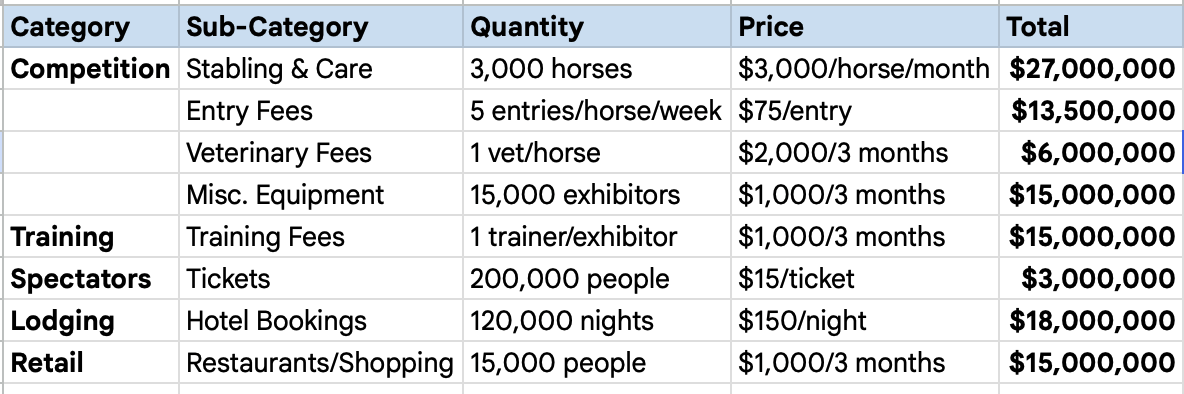
A successful resolution of this case requires a two-phased approach: Phase 1: Quantitative Analysis (Economic Impact) 1. Identify Categories: Group revenue into "Competition-related" (fees, stabling, vets) and "Community-related" (hotels, dining, retail). 2. Calculate Totals: Use the provided quantities (3,000 horses, 15,000 exhibitors, 12-week duration) to reach the ~$112.5 million figure. Phase 2: Strategic Brainstorming (Expansion) 1. Internal Strategies: Focus on increasing the number of exhibitors, improving venue quality, and making the sport accessible to the local community through carnivals and instructional pamphlets. 2. External Strategies: Propose partnerships with media (e.g., NBC Sports), local tourism boards, and luxury sponsors (e.g., Rolex). 3. Evaluation & Risk: For every suggestion, identify potential risks, such as high capital expenditure (CAPEX) for property acquisition or the risk of "reputational damage" if the brand loses its elite status
Practice Sessions
Note: Accepted practice sessions will be available in your profile under "My Practice Sessions".
Case Materials
Submissions (0)
Be the first to comment on this case.

Practice with AI
Sharpen your skills by practicing this case with our AI-powered consultant.
Practice Sessions
Note: Accepted practice sessions will be available in your profile under "My Practice Sessions".