GlobaPharm Pharmaceuticals

Expert
Pharmaceuticals
Mergers & Acquisitions
Public View

Practice with AI

Hone your skills by practicing this case with our AI-powered consultant.

GlobaPharm, a $10B German pharmaceutical company specialising in small-molecule drugs, is considering acquiring BioFuture, a leading San Francisco-based biologicals start-up valued at $1B to rapidly enter the fast-growing biologicals segment. This case covers acquisition criteria, pipeline valuation methodology, break-even analysis on R&D investment, and post-merger integration risks.

- GlobaPharm has a long track record in small-molecule drugs (e.g., aspirin, blood pressure medications) but has no biologicals capabilities. - Biologicals are a rapidly growing drug class treating conditions beyond the reach of traditional drugs — competitors are already several years ahead. - BioFuture was founded 12 years ago by prominent scientists, employs 200 people, and is publicly traded at approximately $1B market capitalisation. - GlobaPharm's options for entering biologicals: build from scratch, partner with start-ups, or acquire. It has chosen to pursue acquisition. - McKinsey has been engaged to evaluate whether GlobaPharm should acquire BioFuture and advise on strategic fit.

Should GlobaPharm acquire BioFuture at its current $1B valuation, and does BioFuture's pipeline, capabilities, and strategic fit justify the investment, accounting for integration risks and the significant R&D investment required to unlock its full value?
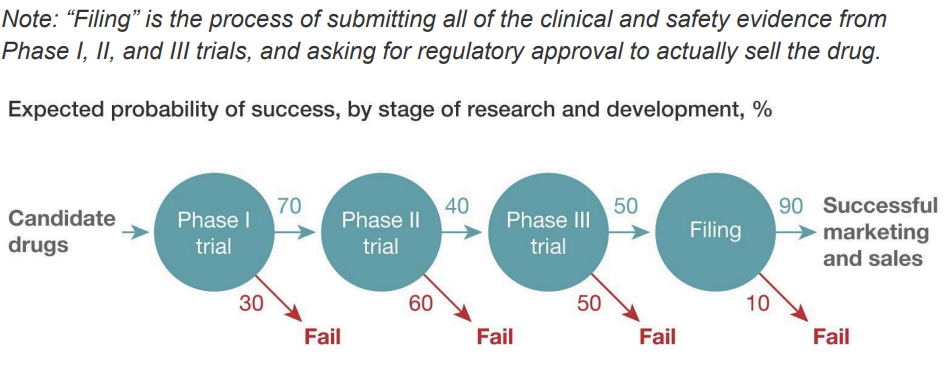
- BioFuture valuation: ~$1B at current share price - Pharma R&D success rates: Phase I ~70%, Phase II ~40%, Phase III ~50%, Filing ~90% — combined probability to market ≈ 12.6% - Primary drug candidate value if successfully marketed: $1.2B (PV of future profits) - Additional Phase II investment proposed: $150M to improve Phase II success rate - Break-even Phase II success rate: must increase from 40% to 80% (i.e., doubling) for the $150M investment to break even - Current combined Phase I+II success: 70% × 40% = 28%; must rise to 56% to justify additional investment
Exhibit 1
Q1 What factors should the team consider when evaluating whether GlobaPharm should acquire BioFuture?
Value of BioFuture's current drug pipeline: number, quality, revenue potential of drugs in development
R&D capabilities: scientific talent, IP, proprietary processes, laboratory infrastructure
Sales and marketing capabilities, including key opinion leader relationships in biologicals
Acquisition price relative to intrinsic value of pipeline and capabilities
GlobaPharm's alternatives: other acquisition targets, partnership models, or organic capability building
Q2 What issues should the team consider when evaluating BioFuture's existing drug pipeline?
Remaining R&D cost to bring each drug to market
Potential revenues and market size (patient population, pricing power, competitive products)
Risk-adjusted probability of regulatory approval at each pipeline stage
Patent strength and IP protection against competitor replication
Manufacturing and distribution costs; side effects and legal exposure from adverse reactions
Competitive pipeline: are rivals developing substitutes at a faster pace?
Q3 By how much would the Phase II success rate need to increase for the $150M additional investment to break even?
If a drug passes Phase II: combined Phase III + Filing success = 50% × 90% = 45%
Value of a drug passing Phase II: 45% × $1.2B = $540M
To break even: need $540M + $150M = $690M value per drug entering Phase III
Required combined Phase I+II probability: $690M ÷ $1.2B = 57.5% → approximately 56%
Required Phase II success rate: 56% ÷ 70% (Phase I) = 80%
Conclusion: Phase II success rate must double from 40% to 80% — a very high bar
Q4 What are the major risks of integrating BioFuture's and GlobaPharm's R&D functions?
Scientific misalignment: different therapeutic focus areas may prevent meaningful collaboration
Culture clash: GlobaPharm's process-driven culture may suppress BioFuture's entrepreneurial R&D environment
Language and communication barriers between German and US-based teams
Management difficulty from a 9-hour time zone difference across key R&D operations
Key talent attrition: acquisition wealth or cultural resistance may trigger departures of critical scientists

- Structure the acquisition evaluation across three axes: strategic fit, financial value, and integration risk - Conduct a drug pipeline DCF valuation adjusted for stage-specific success probabilities — do not rely solely on market capitalisation - Benchmark BioFuture against alternative acquisition targets and partnership options before committing to exclusivity - The 80% Phase II success rate threshold is a critical insight — present this to the board as a risk flag on additional R&D investment - Design a culture integration plan pre-close: ring-fence BioFuture's R&D team, preserve flat hierarchy and scientific autonomy - Retain key scientific founders through equity rollovers, milestone bonuses, and academic publication rights - Establish a joint scientific committee to align therapeutic focus and avoid duplicative R&D within 6 months of closing

Practice Sessions

No practice sessions have been proposed yet. Be the first to propose one!

Note: Accepted practice sessions will be available in your profile under "My Practice Sessions".

Case Materials

Submissions (0)

Sort by:

Be the first to comment on this case.

Published May 10, 2025 • 50 views
Firm/University: McKinsey & Company
No ratings yet
0