
Eco-Friendly Shampoo
Practice with AI
Hone your skills by practicing this case with our AI-powered consultant.
An Australian eco-friendly shampoo company is planning to expand sales into the US market and must decide where to locate its production facility. The candidate is asked to help the client choose between producing in Australia (exporting to the US) or setting up a new production site in the US. This is an operations and strategic decision-making case that rewards structured, objective-driven thinking over rote framework application. It tests the candidate’s ability to identify the right criteria, structure a decision matrix, and make a recommendation.
Our client is an eco-friendly shampoo company headquartered in Australia. The company has established a strong domestic market position, built on its brand credentials around sustainability, natural ingredients, and environmentally responsible manufacturing. The client has identified the US as its primary international expansion target, given: The large and growing US market for natural and eco-conscious personal care products. Increasing consumer preference for sustainable brands in the US, particularly among millennials and Gen Z. Limited competition from direct eco-friendly Australian brands in the US at present. To serve the US market, the client must decide between two production options: Option A — Produce in Australia and export finished goods to the US. Option B — Establish a new production facility in the US. The client has engaged L.E.K. Consulting to evaluate the two options and recommend the optimal approach for entering the US market.
An eco-friendly shampoo company based in Australia wants to expand and sell in the US. They are currently debating whether to export from Australia or set up their production site in the US. Help them decide where to set up their production.
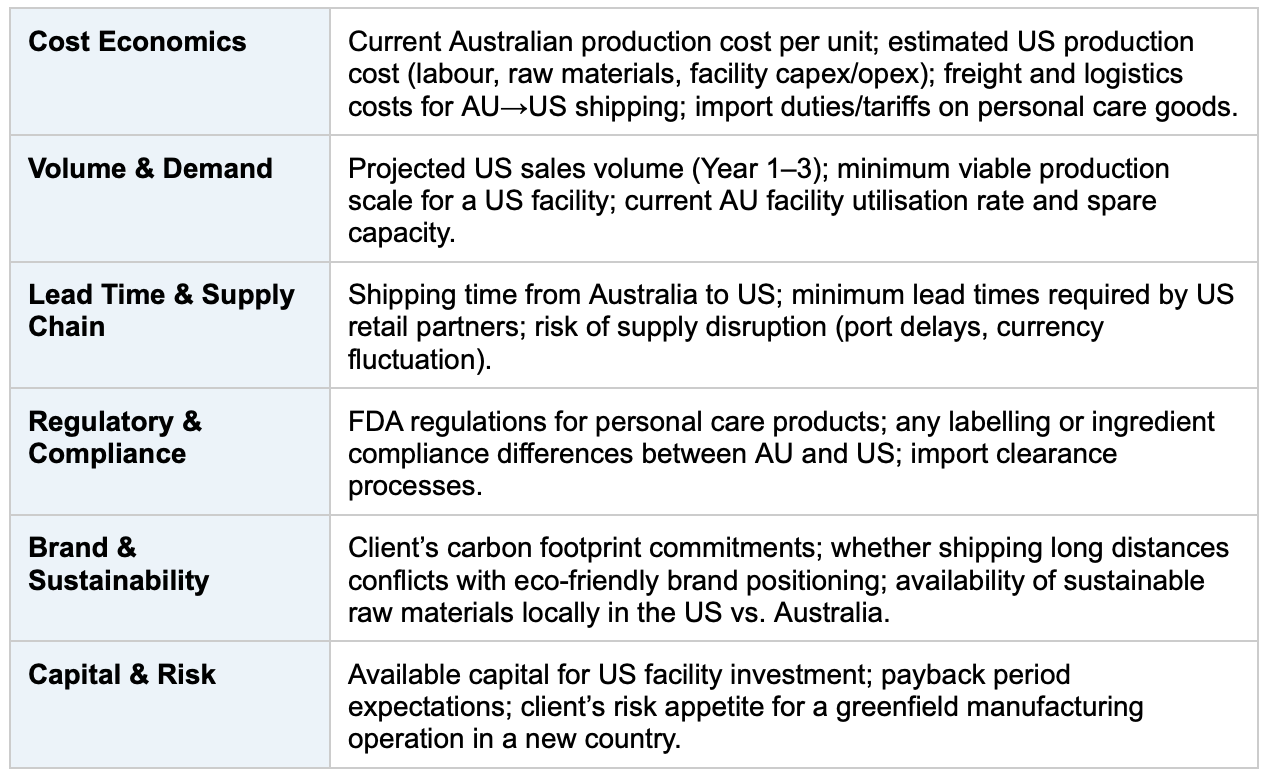
Step 1 — Clarify Objectives & Constraints Confirm the client’s primary objective: minimise cost, speed to market, protect brand, or maximise long-term profitability? Identify any hard constraints (e.g., capital ceiling, eco-certifications, launch timeline). Ask about the intended US distribution model (retail, DTC, wholesale) as this drives lead time requirements. Step 2 — Define Decision Criteria Propose a set of weighted criteria to evaluate both options, for example: Unit economics (cost per unit delivered to US customer) Speed and reliability of supply Brand / sustainability alignment Capital intensity and financial risk Operational complexity in a new market Step 3 — Evaluate Each Option For Option A (Export from Australia): Likely lower upfront capex; leverages existing facility and processes. Higher per-unit logistics cost; longer lead times; currency risk; potential brand tension. Viable for low initial volumes; less operational risk in Year 1. For Option B (US Production Facility): Higher capex and operational complexity; requires new talent and supply chain setup. Better long-term unit economics at scale; shorter lead times; stronger ‘local’ brand narrative. Greater risk if US volume projections are missed. Step 4 — Quantify & Stress-Test Calculate break-even volume: at what annual US sales does Option B become cheaper than Option A? Run a sensitivity check: what happens to Option A economics if AUD strengthens by 10%? If freight costs rise 20%? Assess downside scenario: if Year 1 US volumes are 50% of forecast, which option is more resilient? Step 5 — Recommend Lead with a clear recommendation: “Based on the analysis, we recommend [Option] because [primary reason], subject to [key condition].” A nuanced but defensible answer: likely a phased approach — export from Australia in Year 1–2 to validate demand and build brand, then invest in a US facility once volumes justify the capex. Acknowledge the brand risk of the export model and suggest mitigations (e.g., carbon offsets, transparency in supply chain communications). Flag the key trigger metrics that should prompt a transition to US production (e.g., sustained US revenue above $X).
Practice Sessions
Note: Accepted practice sessions will be available in your profile under "My Practice Sessions".
Case Materials
Submissions (0)
Be the first to comment on this case.

Practice with AI
Sharpen your skills by practicing this case with our AI-powered consultant.
Practice Sessions
Note: Accepted practice sessions will be available in your profile under "My Practice Sessions".