
Insurance for the Underserved
Practice with AI
Hone your skills by practicing this case with our AI-powered consultant.
The Indian insurance market suffers from significant underpenetration, leaving the majority of the adult population without a financial safety net during crises like droughts, floods, or the death of a breadwinner. To address this, the government is considering leveraging the existing Indian Postal Network to distribute life and non-life insurance products to "underserved" segments. While the initiative faces an initial projected annual loss of $80.25 million, the primary objective is social welfare rather than immediate profitability.
Infrastructure: The Indian Postal Network consists of approximately 150,000 post offices nationwide. Target Population: The "underserved" are defined as the Aspirers and Strugglers segments of the population. Distribution Model: The plan involves using one agent per branch to sell insurance directly to households. Objective: To provide a safety net to as many people as possible in underserved markets.
The Indian government needs to determine the feasibility of using the national postal infrastructure to reach the underserved. Specifically, it must calculate the potential market size, estimate the penetration capacity of the postal network, and evaluate the financial implications of this model.
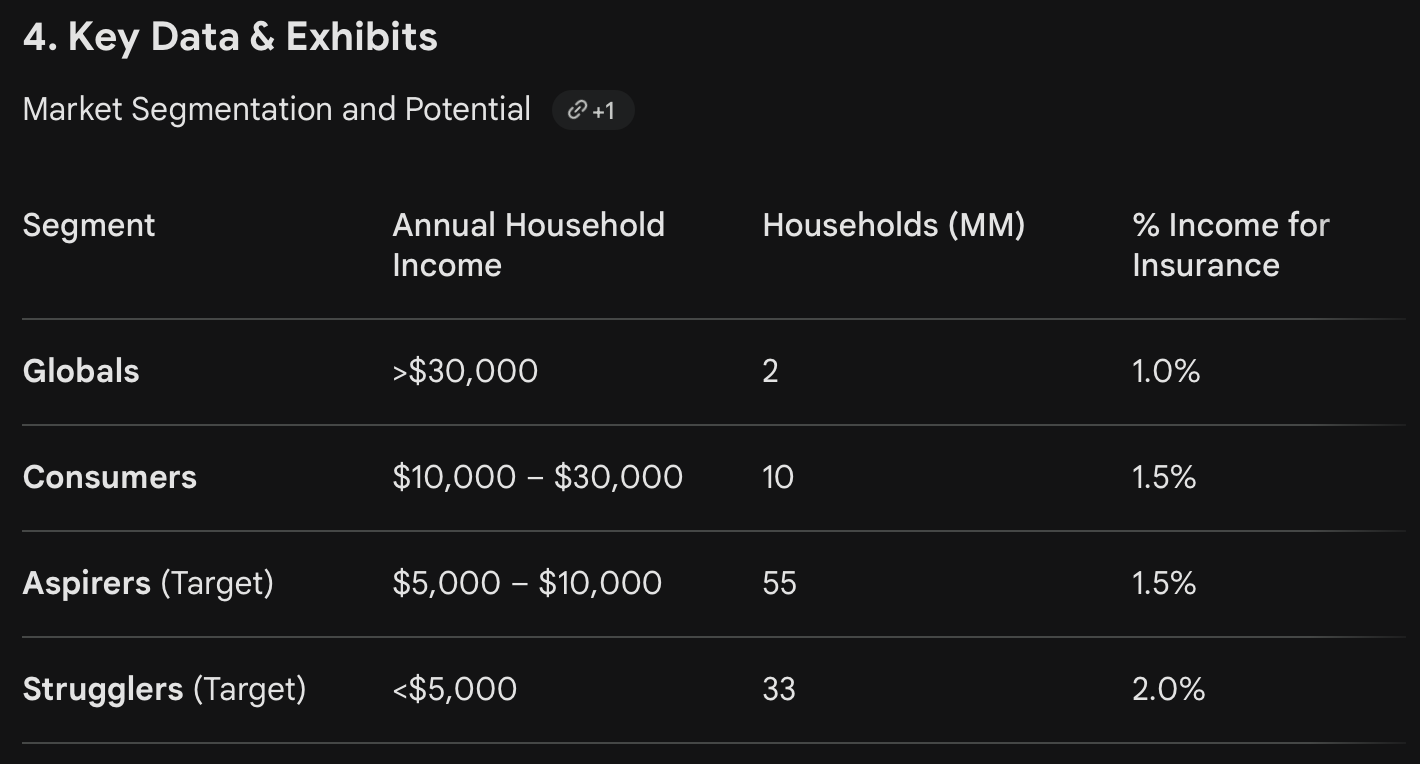
Step 1: Calculate Market Size For the target underserved segments (Aspirers and Strugglers), the total market size is calculated as: (Average Income×Households×Spend %) This results in a total market size of approximately $6.18 billion. Step 2: Determine Postal Sales Capacity Based on 50,000 agents, the network can generate $795 million in annual premium sales, representing a 12.85% market share. Step 3: Evaluate Financials Revenue: $795,000,000 Total Costs: $875,250,000 (driven largely by claims and operational overhead) Bottom Line: A loss of $80,250,000. Step 4: Final Recommendation The government should pursue the initiative despite the loss, as the core objective is social welfare and providing a safety net, not profit. To improve future profitability, the government should: Refine pricing to reduce relative loss costs. Increase the number of active branches beyond 1/3. Improve agent productivity to reach more households per month.
Practice Sessions
Note: Accepted practice sessions will be available in your profile under "My Practice Sessions".
Case Materials
Submissions (0)
Be the first to comment on this case.

Practice with AI
Sharpen your skills by practicing this case with our AI-powered consultant.
Practice Sessions
Note: Accepted practice sessions will be available in your profile under "My Practice Sessions".