
National Park Service
Practice with AI
Hone your skills by practicing this case with our AI-powered consultant.
Our client is the United States Department of the Interior, which is responsible for theNational Park Service (“NPS”). The NPS employs park rangers across all federally owned parks, ranging from Yellowstone and the Grand Canyon to the Statue of Liberty and Lincoln Memorial.
The National Park Service (NPS), overseen by the United States Department of the Interior, employs park rangers across all federally owned parks — from Yellowstone and the Grand Canyon to the Statue of Liberty and the Lincoln Memorial. Rangers are organized into four classifications: Law Enforcement, Education, Maintenance, and Administrative. Law Enforcement rangers carry the most specialized and high-stakes responsibilities, analogous to police and firefighters, with training in wilderness medicine and search and rescue. Their replacement cost is approximately ten times higher than other ranger types, making retention a financially material issue. The client has identified a low retention rate among Law Enforcement rangers as a growing concern and has engaged consultants to quantify the problem and develop targeted solutions.
(read to candidate): Our client is the United States Department of the Interior, which is responsible for the National Park Service ("NPS"). The NPS employs park rangers across all federally owned parks. National Parks employ four different classifications of rangers: Law Enforcement, Education, Maintenance, and Administrative. The focus of this case is on the Law Enforcement rangers, who have similar responsibilities to police and firefighters. The client is concerned that job retention is low among the Law Enforcement rangers. They would like you to explore how big the problem is and think about ways to improve it. Core Questions for the Candidate • What are the direct and indirect costs of low ranger retention to the NPS? • How large is the attrition problem, and which ranger type should be prioritized? • What solutions can address the root causes of Law Enforcement ranger attrition? • What is your final recommendation to the NPS Director?
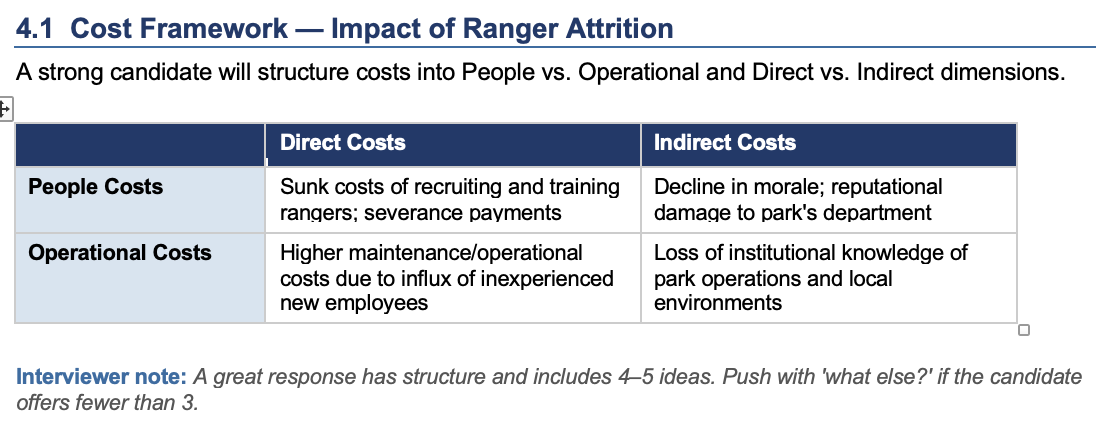
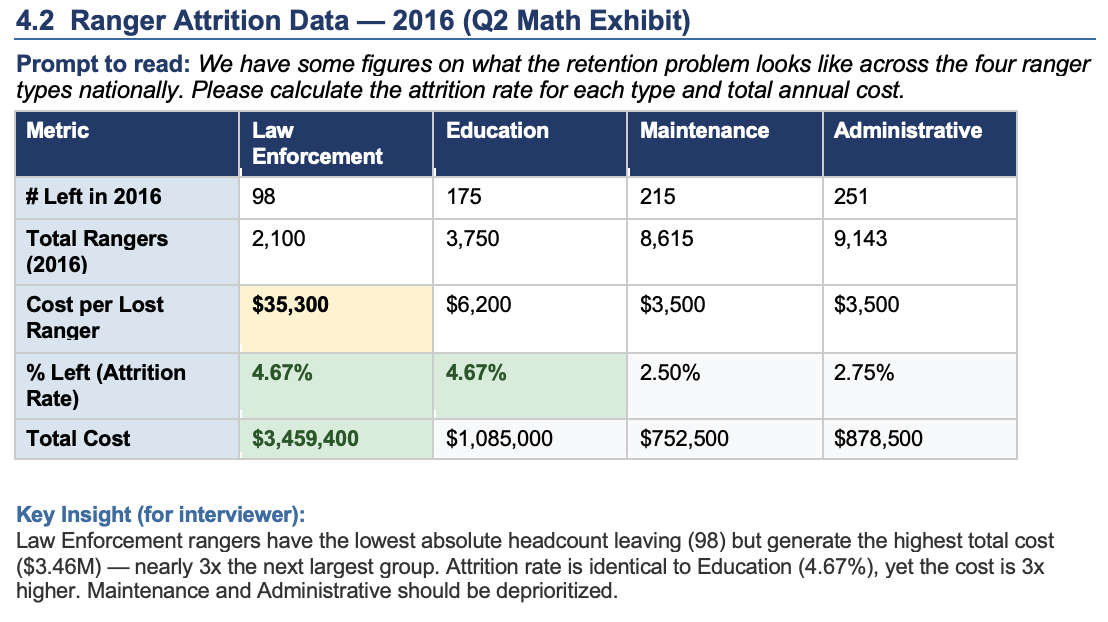
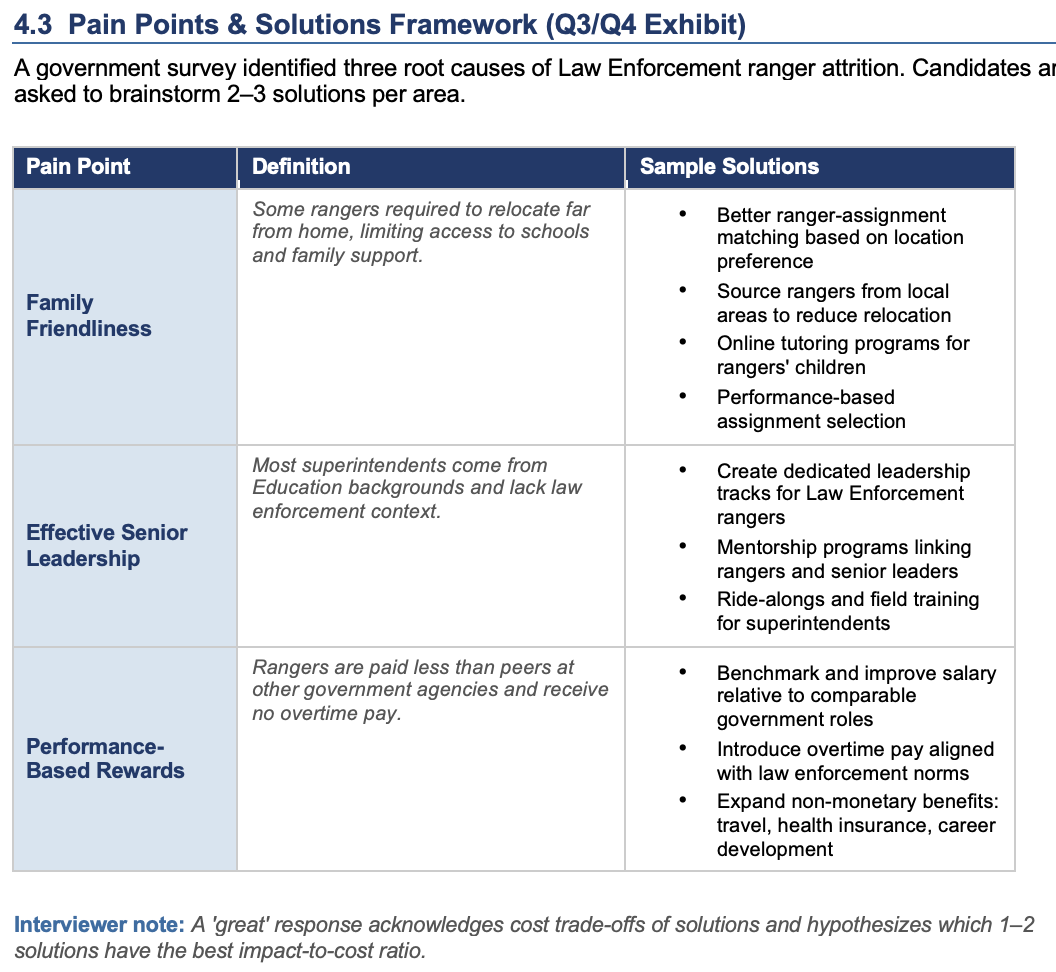
1. Framework This is a retention/organizational effectiveness case. A strong candidate structures the work in three phases: quantify the problem, diagnose root causes, and recommend solutions. The math (Q2) provides the anchor — Law Enforcement rangers are the clear priority based on cost, not volume. Quantify Cost of Attrition → Identify Root Causes → Brainstorm Solutions → Prioritize & Recommend 2. Prioritization Logic The data drives a clear prioritization: focus all retention efforts on Law Enforcement rangers. Even though fewer leave in absolute numbers, their $35,300 replacement cost — over 5x that of other categories — makes them the only group where intervention generates meaningful ROI. • Law Enforcement: 98 leavers × $35,300 = $3.46M — Priority #1 • Education: 175 leavers × $6,200 = $1.09M — Monitor but deprioritize • Administrative & Maintenance: combined $1.63M — Lowest priority 3. Recommended Solutions High-Impact / Lower Cost • Mentorship & ride-along programs for superintendents — low cost, high signal to rangers • Performance-based assignment matching — improves family friendliness without structural change High-Impact / Higher Cost (Requires Budget Approval) • Salary benchmarking and overtime implementation — directly addresses pay gap vs. other agencies • Dedicated Law Enforcement leadership tracks — addresses the core leadership credibility gap 4. Synthesis for NPS Director "The NPS is losing $3.46M annually from Law Enforcement ranger attrition alone — by far the costliest category despite the lowest absolute headcount leaving. Root causes center on family disruption from forced relocations, a leadership gap where superintendents lack law enforcement context, and a pay gap relative to comparable government roles. We recommend prioritizing two near-term interventions: implementing performance-based assignment matching to address family concerns at low cost, and benchmarking salaries to close the compensation gap. Together, these target the two highest-rated pain points and can be piloted within the current budget cycle." 5. Next Steps 1. Conduct detailed cost-benefit analysis on salary benchmarking vs. peer government agencies. 2. Design and pilot a location-preference matching system for Law Enforcement ranger assignments. 3. Engage superintendents in a leadership development program, beginning with field ride-alongs. 4. Set a 12-month retention improvement target and establish tracking dashboards by ranger type.
Practice Sessions
Note: Accepted practice sessions will be available in your profile under "My Practice Sessions".
Case Materials
Submissions (0)
Be the first to comment on this case.

Practice with AI
Sharpen your skills by practicing this case with our AI-powered consultant.
Practice Sessions
Note: Accepted practice sessions will be available in your profile under "My Practice Sessions".