
Sports Bar
Practice with AI
Hone your skills by practicing this case with our AI-powered consultant.
Your client is an entrepreneur looking to invest in a new bar. He needs to determine how profitable the company will be and convince his primary investor, his father, that it will be a viable business
Your client is an entrepreneur looking to invest in a new bar. He needs to determine how profitable the company will be and convince his primary investor, his father, that it will be a viable business What factors would you consider and investigate?
The entrepreneur needs to determine whether the sports bar will be sufficiently profitable to justify a $500K startup investment, and how to frame that opportunity convincingly to his father relative to alternative uses of that capital.
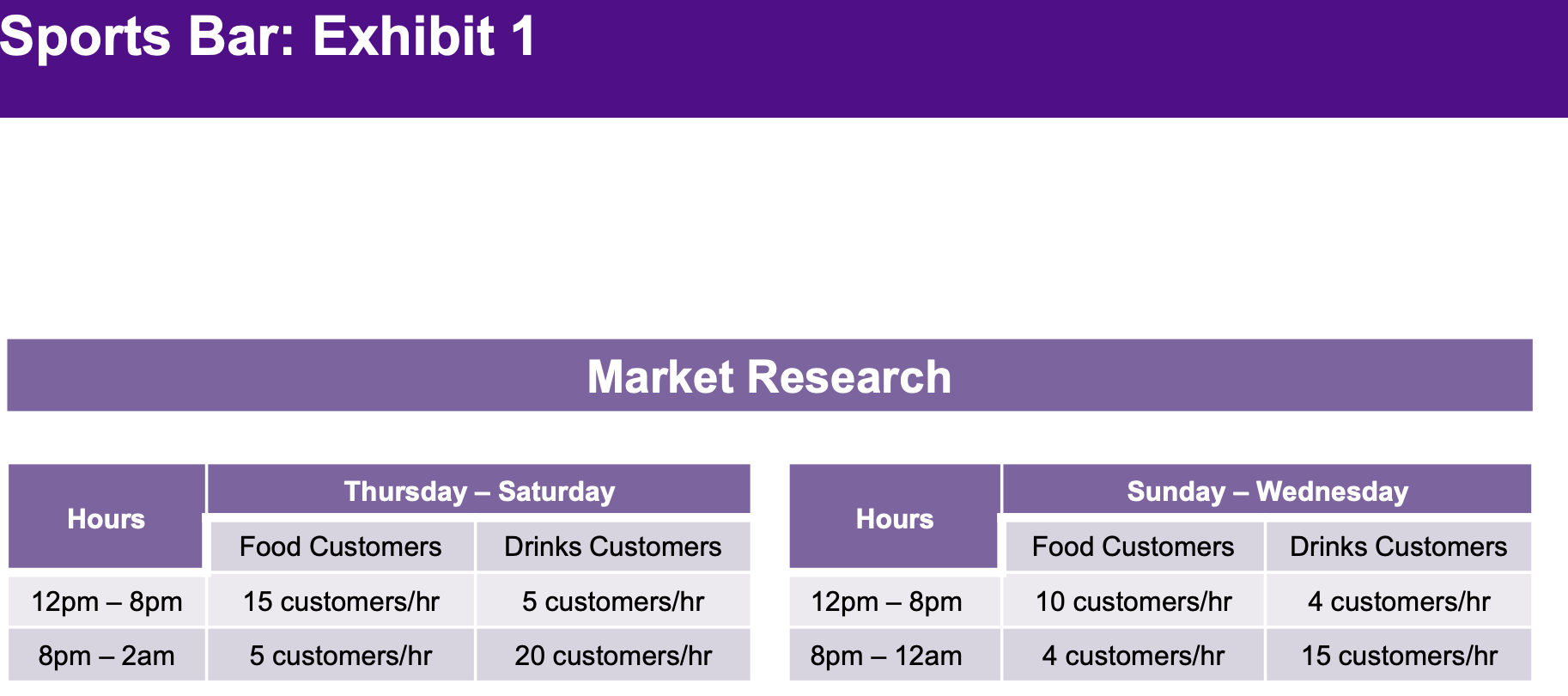
Opening framework should cover two main branches: revenue drivers (customer volume by segment and time, average spend per visit, food vs. drinks mix) and cost drivers (COGS, labor, fixed costs like lease, and unquantified startup costs). A strong candidate will also proactively flag missing costs — utilities, marketing, permits, insurance — and note these as risks. For the profitability build, segment the week into Thu–Sat and Sun–Wed, and each day into daytime and nighttime blocks. Calculate daily orders, scale to weekly, then apply revenue and cost assumptions in sequence. Verbalize each step clearly. For Q1, compute break-even by dividing startup costs by annual profit, then calculate 5-year ROI. The key insight is that while the business is technically profitable, the returns are very thin — especially given the unaccounted costs — making this a difficult investment to justify against alternatives like index funds or real estate. Final recommendation should acknowledge the business is viable on paper but borderline as an investment. To strengthen the pitch to the father, the client should explore ways to reduce startup costs (used equipment, minimal renovation), add revenue streams (advertising, jukebox, events), and optimize the operating model toward higher-margin drinks. The recommendation must also flag the significant risks: unquantified costs, location sensitivity, COGS volatility, and minimum wage exposure.
Practice Sessions
Note: Accepted practice sessions will be available in your profile under "My Practice Sessions".
Case Materials
Submissions (0)
Be the first to comment on this case.

Practice with AI
Sharpen your skills by practicing this case with our AI-powered consultant.
Practice Sessions
Note: Accepted practice sessions will be available in your profile under "My Practice Sessions".