
Soybean Processing
Practice with AI
Hone your skills by practicing this case with our AI-powered consultant.
You are the owner of a large soybean farm in Argentina facing a strategic supply chain decision: should soybeans be processed in South America before shipping to Asia, or shipped raw to Asia for processing there? This is a classic operations and supply chain case that tests the candidate's ability to identify and structure the factors driving a location-of-processing decision for a commodity business. The case rewards structured multi-criteria thinking over any single dominant framework.
You are the owner of a large soybean farm in Argentina. Soybeans are a commodity product grown primarily in South America (Argentina, Brazil). Demand for soybeans is growing rapidly in Asia, driven by: - Rising middle-class consumption of soy-based foods and protein. - Growth of the Asian aquaculture and livestock feed industries. - Increasing use of soybean oil in food processing and biofuels. As a soybean producer, you must decide on the optimal configuration of your supply chain to serve Asian customers: Option A — Process soybeans in South America (Argentina), then ship processed goods (soy meal, soy oil) to Asia. Option B — Ship raw soybeans to Asia and process them there.
Assume that you are the owner of a large soybean farm in Argentina. Soybeans are a commodity product. Most soybeans are grown in South America, but demand is growing rapidly in Asia. You are trying to decide whether to process soybeans in South America and ship them to Asia, or to ship raw soybeans directly to Asia and process them there. What factors would you look at to make this decision?
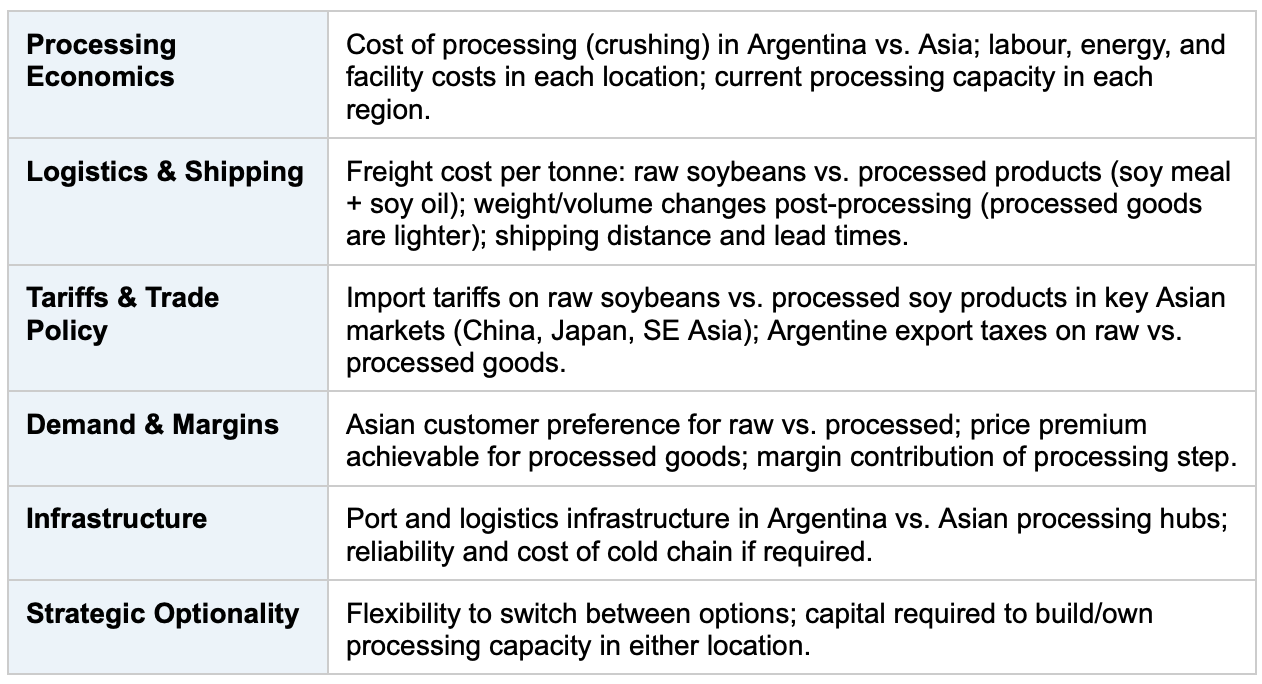
Step 1 — Define Decision Criteria Processing economics (cost per tonne), logistics cost differential, tariff impact, demand-side price premium, and strategic flexibility. Step 2 — Evaluate Each Option Against Criteria Build a side-by-side comparison of net margin under Option A vs. Option B. Key calculation: Net margin = (Selling price − Production cost − Processing cost if A − Shipping cost − Tariffs). Step 3 — Identify Swing Factors The decision likely hinges on: (1) tariff differential and (2) processing cost gap between Argentina and Asia. Argentina export tax policy on raw beans has historically favoured processing domestically — flag this. Step 4 — Recommend If Argentine processing costs are competitive and tariffs on processed goods in Asia are not prohibitive: recommend Option A (process in Argentina) to capture margin and reduce raw commodity exposure. If Asian tariffs on processed goods are high or Asian processing is significantly cheaper: Option B (ship raw) is preferred. Flag the need to model both scenarios with real tariff data before committing capital to processing infrastructure.
Practice Sessions
Note: Accepted practice sessions will be available in your profile under "My Practice Sessions".
Case Materials
Submissions (0)
Be the first to comment on this case.

Practice with AI
Sharpen your skills by practicing this case with our AI-powered consultant.
Practice Sessions
Note: Accepted practice sessions will be available in your profile under "My Practice Sessions".