
Promotional Planning
Practice with AI
Hone your skills by practicing this case with our AI-powered consultant.
A national grocery and drug store chain using a high-low pricing strategy is underperforming its competitors on promotional sales lift. Despite matching competitors on pricing, discount depth, and promotion timing, the client consistently fails to generate comparable volume spikes during promotions. The root cause lies in inventory planning and execution — not price or marketing. This case challenges candidates to diagnose a supply-demand mismatch and propose a operational fix.
Client: National grocery and drug store chain Pricing Model: High-low pricing = everyday prices are slightly above everyday-low-price (EDLP) retailers, but the client periodically offers significant promotional discounts paired with print and in-store advertising. Strategic Commitment: The client has explicitly ruled out shifting to an EDLP model. Their goal is to become the leading high-low grocer in the industry.Competitive Landscape: One to two major high-low competitors operate in each local region. The client's everyday prices, promotional cycle timing, and discount percentages are virtually identical to these competitors. Current Promotion Planning Process: - Store managers place promotional orders several weeks in advance - Order quantities are based on past similar promotions and subjective gut feel (most managers have 10+ years of experience) - If shelves run low, managers can place emergency orders by mid-afternoon for next-morning delivery — but stockouts are sometimes only discovered when customers complain - Distribution center buyers have access to historical sales data for similar promotions but do not receive enough lead time to incorporate store-level orders into supplier orders
Despite offering promotions that are structurally identical to competitors (same prices, same discount depth, same timing), the client generates lower sales lift during promotions than industry benchmarks. Customers frequently complain that promoted items are out of stock during the promotion window, suggesting the issue is not demand, it is the client's inability to fulfill that demand.
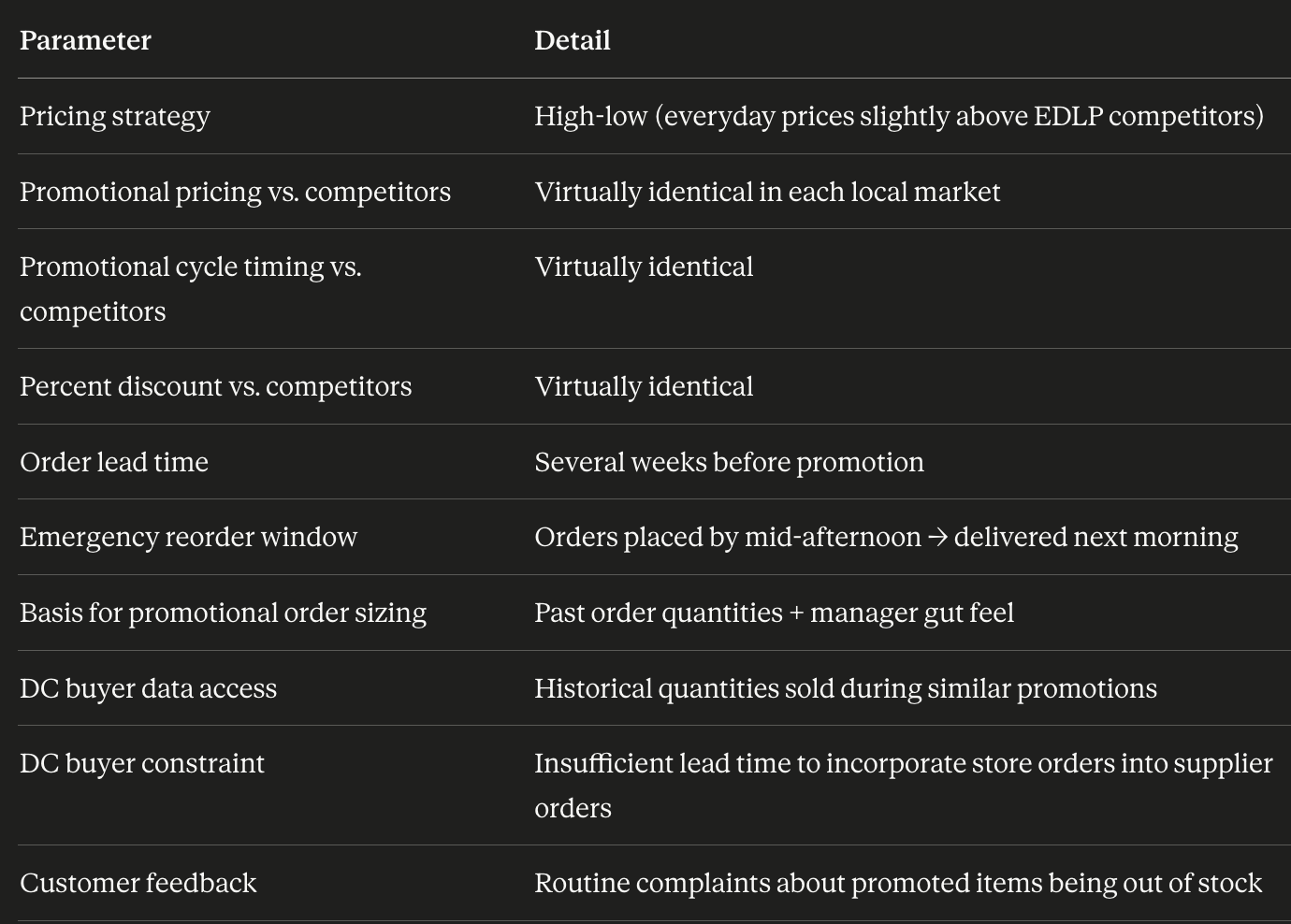
Root Cause: The client's promotional sales underperformance is driven by systematic stockouts caused by inaccurate demand forecasting and poor inventory visibility — not by pricing, advertising, or customer preference. Step 1 — Fix the Forecasting Input Shift promotional order sizing from quantities ordered in past promotions to quantities sold in past promotions. This is a foundational data correction. Store managers and DC buyers both have access to historical sales data but are not consistently using it as the primary forecasting input. Step 2 — Improve Real-Time Inventory Visibility Implement scheduled shelf-check routines for promoted items throughout the day, with mandatory checks before the daily order cutoff (mid-afternoon). This creates an early-warning system for faster-than-expected sell-through and allows managers to place emergency replenishment orders before stockouts occur. Longer term, real-time POS-linked inventory tracking for promoted SKUs would automate this signal. Step 3 — Improve DC-to-Supplier Lead Time Coordination Give distribution center buyers earlier visibility into store-level promotional forecasts so supplier orders can be sized more accurately before the promotion window opens. This requires improving the information flow between store ordering and DC procurement — likely through a centralized promotional planning system. Step 4 — Build a Closed-Loop Learning System After each promotion, capture and compare forecasted vs. actual sales at the store and DC level. Feed this data back into future promotional planning to progressively reduce forecast error over time. Priority: Steps 1 and 2 are immediately actionable with existing data and processes. Steps 3 and 4 require process and system investment but address the structural root cause at the supply chain level.
Practice Sessions
Note: Accepted practice sessions will be available in your profile under "My Practice Sessions".
Case Materials
Submissions (0)
Be the first to comment on this case.

Practice with AI
Sharpen your skills by practicing this case with our AI-powered consultant.
Practice Sessions
Note: Accepted practice sessions will be available in your profile under "My Practice Sessions".