
Coffee Shop Co.
Practice with AI
Hone your skills by practicing this case with our AI-powered consultant.
A close friend approaches you for advice: she is considering opening a coffee shop and wants to know whether the venture is a sound investment. Your task is to evaluate the financial viability of the business, estimate realistic market demand, understand the cost structure, and arrive at a clear recommendation on whether she should proceed.
Your friend has identified a retail unit in a busy urban neighbourhood. She has saved $50,000 in personal capital and is prepared to invest this as seed funding. She has no prior experience running a food-and-beverage business but has researched the specialty coffee market extensively. The target location sits adjacent to a commuter transit hub, generating high morning footfall. Nearby competitors include two national-chain coffee shops and one independent artisan cafe. Lease terms available are a three-year contract at $4,000 per month. - Potential seed capital: $50,000 (personal savings) - Proposed location: urban transit hub neighbourhood - Competition: 2 chain coffee shops, 1 artisan independent - Lease: 3-year term at $4,000/month (non-negotiable) - Owner has no prior F&B management experience
The client needs a structured assessment of whether opening the coffee shop is a financially viable and strategically sound decision. Specifically, the analysis must answer: - Is the addressable market large enough to support a new entrant? - What level of daily transactions is required to break even? - Can the business generate a positive return within the 3-year lease period? - What are the key operational risks and how can they be mitigated? - Should the client invest her $50,000, and if so, under what conditions?
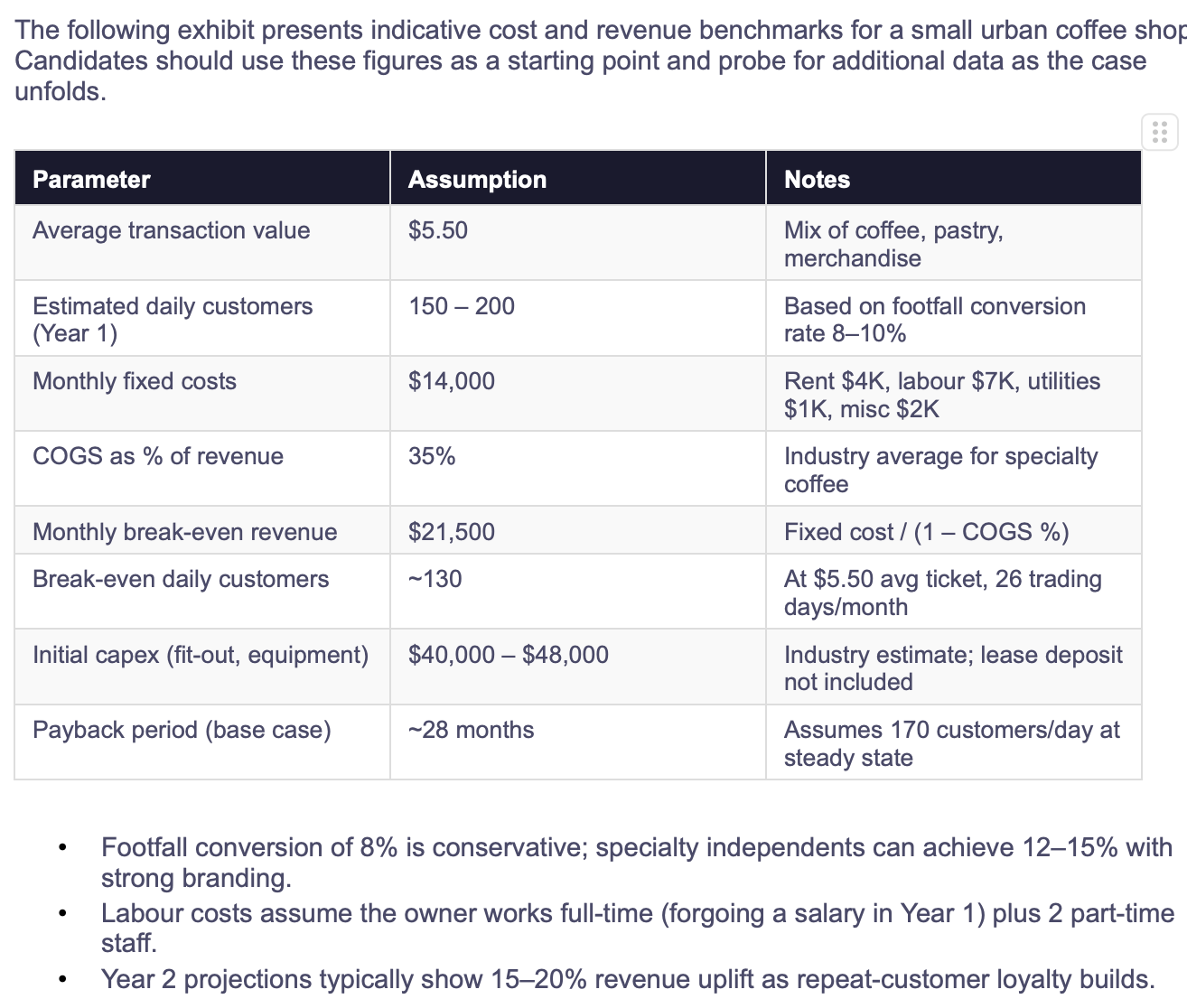
A strong candidate will frame this as a three-part assessment: market sizing, unit economics, and risk evaluation. The recommended approach is: Step 1: Clarify objectives and constraints — confirm the client's financial goals, timeline, and risk appetite before diving into analysis. Step 2: Size the market — estimate footfall at the transit hub, derive a realistic conversion rate, and benchmark against comparable locations. Step 3: Build the unit economics — model revenue (customers × avg ticket), subtract COGS and fixed costs to arrive at operating profit and break-even thresholds. Step 4: Stress-test assumptions — vary key drivers (customer volume, ticket size, COGS) to understand downside scenarios. Step 5: Assess strategic positioning — identify how the shop can differentiate and sustain competitive advantage over the lease term. Step 6: Synthesise and recommend — deliver a clear go / no-go recommendation with defined conditions (e.g., minimum pre-opening commitments, milestones for Year 1). A recommended answer should conclude with a structured "if / then" recommendation: the venture is viable if daily customers exceed ~130, the owner manages costs tightly in Year 1, and she pursues a clear differentiation strategy (e.g., speciality roasts, loyalty programme). If these conditions cannot be met, the $50,000 capital may be better deployed elsewhere.
Practice Sessions
Note: Accepted practice sessions will be available in your profile under "My Practice Sessions".
Case Materials
Submissions (0)
Be the first to comment on this case.

Practice with AI
Sharpen your skills by practicing this case with our AI-powered consultant.
Practice Sessions
Note: Accepted practice sessions will be available in your profile under "My Practice Sessions".