Imported Whiskey

Medium
Manufacturing
Operational Improvement
Public View

Practice with AI

Hone your skills by practicing this case with our AI-powered consultant.

A first-mover imported whisky manufacturer and distributor rode the explosive growth of bar, disco, and karaoke club culture in an emerging market — achieving over 30% annual growth for several years through aggressive channel marketing, exclusive partnerships with top outlets, and event sponsorships. Growth has since decelerated to ~10% per year and profit margins are declining. The case requires candidates to diagnose the root causes of the slowdown across both revenue and margin dimensions, and then develop a portfolio of strategic options to rebuild the growth platform. This is a real-life consulting assignment structured as a classic profitability and strategy case.

Client profile: A manufacturer and distributor of imported whisky operating in an emerging market First mover in promoting whisky through bars, discos, and karaoke clubs — a fast-growing on-premise channel Growth during peak phase: over 30% per year Go-to-market strategy: aggressive channel marketing, exclusive or preferential partnerships with top outlets, event sponsorships, and volume rebates Current situation: Revenue growth has slowed from 30%+ to approximately 10% per year Profit margins are also declining — the company faces a dual squeeze on top-line growth and bottom-line returns The advertising campaign used by the client has remained unchanged for approximately 5 years Market context: The on-premise channel (bars, discos, karaoke) drove the client's initial success but is now maturing Competitors have entered the market, attracted by the client's demonstrated success Consumer behaviour in the channel is evolving — the original wave of whisky adopters is ageing out of the bar/disco demographic

The client has asked the consulting team to address two sequential objectives: Part 1 — Diagnosis: Identify and explain the reasons for the slowdown in revenue growth Understand the drivers of margin compression Part 2 — Strategy: Develop a range of strategic options that could rebuild the client's growth platform Assess the relative attractiveness and feasibility of each option The case combines elements of profitability analysis (disaggregating revenue and cost pressures), market dynamics (maturity, competition, consumer lifecycle), and strategic options generation (brand, channel, geography, and product).
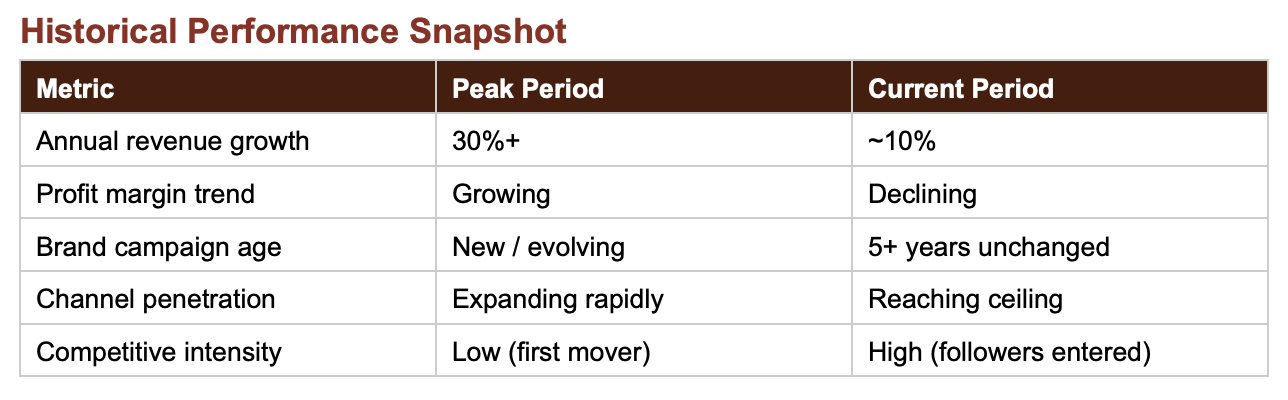
Key Structural Drivers of the Business: Revenue model: Volume-driven on-premise sales through exclusive/preferential outlet partnerships Key cost structure: Trade marketing costs (sponsorships, rebates), import costs subject to currency risk, and outlet partnership investments Growth engine: Historically dependent on the expansion of the bar/disco channel and increasing penetration within that channel Consumer lifecycle: Bar and disco culture tends to be concentrated in younger demographics; as early adopters age, they exit the channel
Exhibit 1
Question 1: What is driving the slowdown in revenue growth?
Candidates should diagnose the slowdown by examining both demand-side and supply-side factors:
Channel maturation:
The bar and disco channel — the primary growth engine — is no longer expanding. The number of new outlets is flat or declining, removing the primary source of distribution-led volume growth
The category has reached a high share of throat (share of drinks consumed) within the on-premise channel. Further penetration gains are limited — the low-hanging fruit has been taken
Competitive erosion:
Competitors, attracted by the client's demonstrated success, have entered the market and invested aggressively in the same channel
Competitors have captured some market share from the client, particularly among newer or smaller outlets
Brand fatigue:
The advertising campaign has been unchanged for five years — generating declining impact and relevance
An ageing brand image impairs the ability to recruit new (younger) consumers and retain existing ones who seek aspirational brands
Consumers lack sufficient incentive to trade up to more premium SKUs, limiting revenue per unit growth
Consumer lifecycle dynamics:
The category lifecycle in on-premise channels is inherently short: consumers frequent bars and discos heavily in their twenties and early thirties, then age out of the channel
The original cohort of whisky adopters recruited by the client is now leaving the bar/disco market, and new younger consumers are not being recruited at a sufficient rate to replace them
Question 2: What is driving profitability down?
Margin compression is being driven by both revenue-side and cost-side forces:
Revenue-side pressure:
Competition has prevented price increases and in some cases driven prices down, directly compressing gross margin
The inability to premiumise — i.e., shift volume to higher-value SKUs — limits revenue per unit improvement
Cost-side pressure:
Trade marketing costs (sponsorships, event partnerships, volume rebates) have increased as outlet owners, now courted by multiple suppliers, have greater bargaining power and can demand more from each partner
As the market expanded, the client began partnering with smaller, lower-traffic outlets — which generate lower return on the fixed investment in sponsorships and rebates
Imported goods are exposed to currency fluctuation risk, which can unpredictably increase the cost of goods
Question 3: What are the potential strategic options?
Candidates should generate a structured portfolio of options across brand, channel, geography, and product dimensions:
Brand revitalisation:
Launch a new advertising campaign to refresh the brand image and improve relevance with younger consumers
Reposition the brand to restore aspirational appeal and signal premium quality, justifying higher price points
Premiumisation:
Encourage existing consumers to trade up to higher-value SKUs (older expressions, limited editions, or premium variants)
Premium SKUs generate higher revenue per unit and higher margins, reducing dependence on volume growth
A revitalised brand image is a prerequisite — premiumisation requires credible aspirational positioning
Higher price points also render head-on price competition with lower-tier competitors irrelevant
Geographic expansion:
Identify rural or secondary urban markets where competition remains limited and the on-premise channel is still growing
Invest in these markets strategically and early — replicating the first-mover advantage that drove original success in tier-one cities
Channel diversification:
Explore in-home consumption occasions: shift some marketing to retail channels where consumers who are ageing out of bars can be retained as whisky drinkers
Enter the restaurant channel as an adjacent on-premise opportunity with a different consumer demographic and age profile
Develop gifting and special occasion positioning to broaden the usage occasions for imported whisky
Operational improvements:
Improve outlet selection: apply a rigorous ROI framework to partnership investments, concentrating spend on high-traffic, high-conversion outlets and exiting low-return partnerships
Innovate on delivery and consumer experience within the bar/disco channel to create differentiation that competitors cannot easily replicate

The recommended strategy for the client has two phases: stabilise the core, then build the growth platform. Phase 1: Stabilise — Protect Margin and Rebuild Brand (Year 1) Immediately apply an outlet ROI framework: exit the bottom quartile of low-return partnerships and redeploy those trade marketing resources to high-traffic, high-value outlets Commission and launch a new brand campaign to arrest the brand fatigue and signal a premium repositioning — this is the foundation for all other strategic moves Conduct consumer research to understand which premium SKUs have the highest up-trade potential and among which consumer segments Begin renegotiating outlet agreements from a position of selectivity rather than coverage — restoring some bargaining power relative to outlet owners Phase 2: Rebuild Growth — New Channels, Markets, and SKUs (Years 1-3) Premiumisation: Launch a trade-up campaign anchored to the revitalised brand, with premium SKUs at a 20-40% price premium over the current flagship; measure conversion rates quarterly Geographic expansion: Identify the top 10-15 secondary cities and rural markets with unmet demand and limited competition; enter in sequence, replicating the first-mover partnership model Channel diversification: Partner with leading retail chains (supermarkets, specialist liquor retailers) to establish an in-home presence; develop a gifting SKU range for festive and special occasion occasions Restaurant channel: Pilot a partnership programme with 50 mid-to-high-end restaurants in two cities; measure whisky adoption rates and margin profile versus bars/discos

Practice Sessions

No practice sessions have been proposed yet. Be the first to propose one!

Note: Accepted practice sessions will be available in your profile under "My Practice Sessions".

Case Materials

Submissions (0)

Sort by:

Be the first to comment on this case.

Published May 10, 2025 • 39 views
Firm/University: OC&C
No ratings yet
0