
Grocery Chain
Practice with AI
Hone your skills by practicing this case with our AI-powered consultant.
A major grocery chain is experiencing declining profits despite stable operating costs. Customer visit frequency has dropped noticeably, but the root cause is unknown. The candidate is asked to diagnose the profitability problem and recommend actionable solutions. This case tests profitability frameworks, revenue decomposition, and hypothesis-driven thinking—core competencies for L.E.K. interviews.
Our client is a major grocery chain operating across multiple locations. Over the past several quarters, management has observed a meaningful decline in overall profitability. Notably: - Operating costs have remained largely steady, ruling out a cost-side shock as the immediate driver. - Customer visit frequency has declined, suggesting a revenue-side problem. - The chain operates in a competitive grocery retail environment, where consumer preferences, pricing dynamics, and alternative channels (e.g., online delivery) are rapidly evolving. The client's leadership team is unable to pinpoint the specific cause of the profit decline and has engaged L.E.K. Consulting to diagnose the issue and develop a set of strategic recommendations.
A major grocery chain is experiencing declining profits. Customer visits have fallen, but operating costs remain steady. What is causing this profit decline, and what should the client do about it?
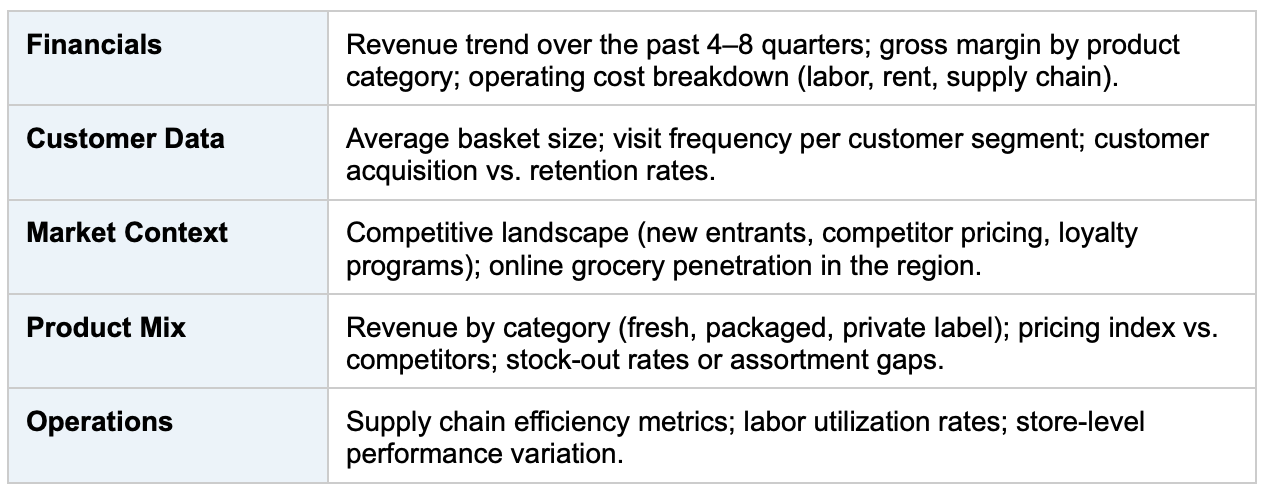
Step 1 — Clarify & Scope Confirm the time period and geography of the profit decline. Ask whether the decline is isolated to certain stores, categories, or customer segments. Establish what “declining profits” means — absolute EBIT, EBIT margin, or net income? Step 2 — Revenue Decomposition Break revenue into: Revenue = Number of Visits × Average Basket Size × Average Price per Item Identify which lever is moving: visits, basket size, or pricing. Segment further by store location, customer cohort, or product category. Step 3 — Diagnose Root Cause Prioritise hypotheses across four buckets: Customer Behaviour — Shift to online, change in frequency or spend patterns. Competition — New entrants, improved competitor value propositions (delivery, loyalty, price). Pricing & Product — Price competitiveness, assortment gaps, product quality issues. Cost Structure — Even if flat overall, check for category-level margin erosion. Step 4 — Quantify & Prioritise Use any data exhibits provided to size each driver’s contribution to the profit gap. Focus recommendations on the 1–2 levers with the highest impact and feasibility. Step 5 — Recommend Lead with a clear, structured recommendation: “Based on the analysis, the primary driver is [X]. We recommend the client focus on [Y] to recover [Z] in profit contribution.” Potential solutions may include: dynamic pricing or targeted promotions, loyalty programme enhancements, assortment rationalisation, an online/delivery channel investment, or specific operational improvements. Acknowledge risks and suggest quick wins vs. longer-term initiatives.
Practice Sessions
Note: Accepted practice sessions will be available in your profile under "My Practice Sessions".
Case Materials
Submissions (0)
Be the first to comment on this case.

Practice with AI
Sharpen your skills by practicing this case with our AI-powered consultant.
Practice Sessions
Note: Accepted practice sessions will be available in your profile under "My Practice Sessions".