
Clothing Chain Acquisition
Practice with AI
Hone your skills by practicing this case with our AI-powered consultant.
Yermakov Ltd., a global clothing retailer, has acquired a dozen high-end local boutiques as part of a strategy to localize its brand. Six months after the acquisitions closed, the company is struggling. Acquired employees are walking out, long-time Yermakov staff are anxious, and the local fashion segment is not gaining traction with customers. Yermakov has brought in Deloitte Human Capital to stabilize the workforce and build a change management plan.
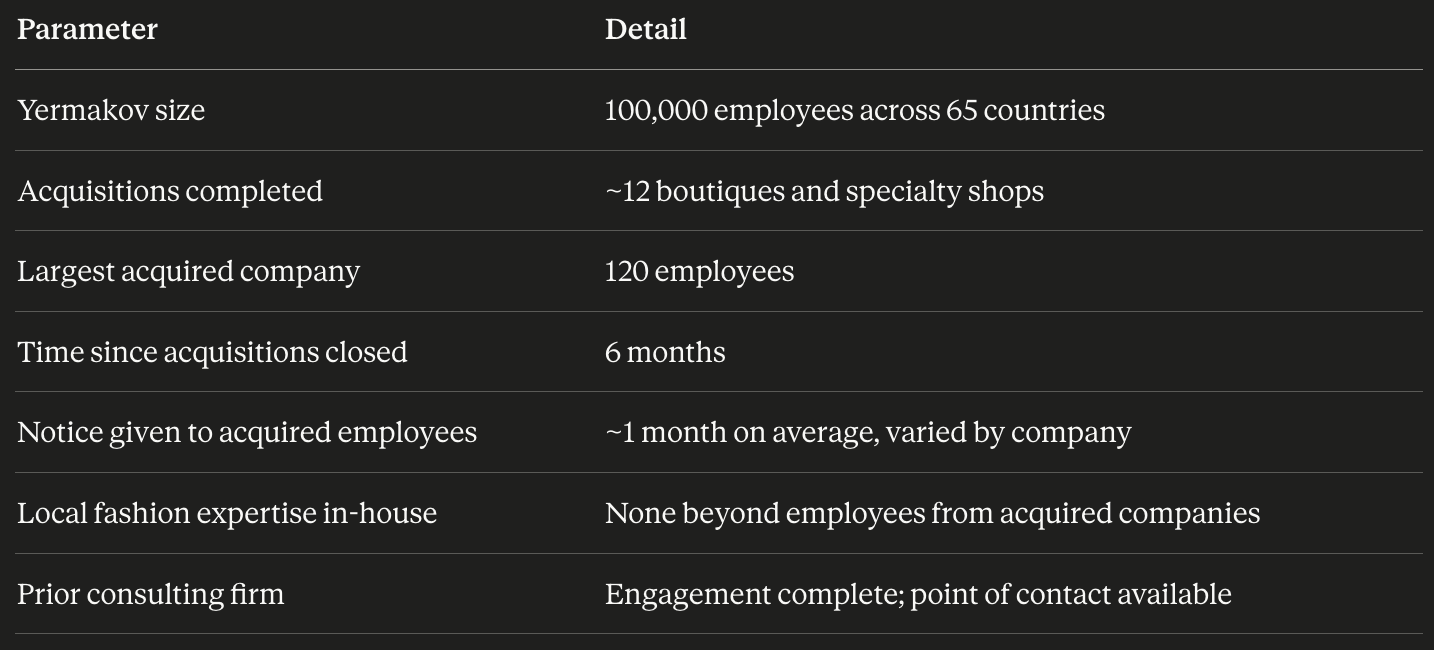
Yermakov Ltd. is a US-based clothing company operating across 65 countries with 100,000 employees worldwide. To localize its image, Yermakov has acquired roughly 12 high-end boutiques and specialty clothing shops in markets where it already has a presence. These acquired businesses are very different from Yermakov in character: - They source exclusively through fair trade channels - They have close, trust-based relationships with their suppliers and customers - They are small, with the largest acquired company having only 120 employees - Their employees carry deep, specialized knowledge about local fashion and care deeply about the work they do Yermakov spent the prior year working with a separate consulting firm to complete the acquisition deals. That firm is no longer engaged, though a point of contact remains available. Deloitte Human Capital is now being brought in to address what has emerged on the people and culture side. Additional context from the case: - Acquired company employees received roughly one month of advance notice before the acquisitions closed, though this varied by company - The acquisitions were intentionally done in markets where Yermakov already operates - Yermakov has no internal team with local fashion expertise outside of the people who came through the acquisitions
Six months into the post-acquisition period, Yermakov is dealing with three connected problems: Talent attrition: A significant number of employees from the acquired boutiques turned down offers to stay on under Yermakov, taking their specialized knowledge and relationships with them. Revenue shortfall: Customer acquisition and retention in the local fashion segment is coming in below expectations, which threatens the commercial rationale for the acquisitions. Internal anxiety: Long-time Yermakov employees are unsettled by the changes happening around them, and this is showing up in their day-to-day performance. Yermakov has engaged Deloitte Human Capital to stabilize the workforce and help the company communicate a clear and credible change agenda.
This is a Human Capital case, not a traditional profitability or market sizing case. Numbers will not drive the answer here. The recommended framework organises the work across three prioritised streams, each broken into Assess, Implement, and Evaluate phases. Business Issues: Acquisition Management and Workforce Stabilization Work Stream 1: Change Management and Communication (highest priority) Assess: Run a stakeholder analysis covering both internal groups (Yermakov leadership, long-time employees, acquired company staff) and external groups (customers, fair trade suppliers, local community partners). Conduct a change readiness assessment. Review the work done by the prior consulting firm before duplicating any effort. Implement: Build a change management strategy that gives employees a clear line of sight into what the acquisition means for them. Communications need to be direct and specific, covering the vision, a realistic timeline, and the concrete steps Yermakov is taking to get there. Set up two-way communication channels so employees can surface concerns rather than sit with them. All-hands meetings, a company intranet, and regular pulse surveys are practical tools here. The underlying goal is to demonstrate that leadership has a plan and is executing against it. Evaluate: Track progress along the change curve. Measure awareness, understanding, and adoption rates. Monitor open rates on change communications and use pulse surveys to catch problems early. Business impact to flag: Movement along the change curve directly supports Yermakov's ability to recoup the investment it made in these acquisitions by slowing attrition and improving morale. Work Stream 2: Talent Strategy Assess: Conduct a skills gap analysis to understand what capabilities Yermakov now needs but does not have, particularly in local fashion. Use pulse surveys and employee listening tools to understand what is driving attrition. Run a compensation and benefits benchmarking exercise, since unequal benefits across legacy and acquired employees often creates quiet resentment that accelerates turnover. Implement: Build a talent strategy and roadmap. Use competency modeling to define the skills profile Yermakov needs for its next chapter. Develop career paths for both legacy and acquired employees so people can see a future for themselves inside the combined organization. Introduce a rewards and recognition program. Consider professional rotation programs that send Yermakov employees to the acquired boutiques and vice versa, which builds cross-functional knowledge and breaks down the "us vs. them" dynamic. Evaluate: Track employee engagement scores, offer and acceptance rates, retention rates across both employee groups, and external employer ratings. Business impact to flag: Holding onto the talent from acquired companies is the whole point. The specialized knowledge, supplier relationships, and customer trust these employees carry are the core value of what Yermakov bought.
Practice Sessions
Note: Accepted practice sessions will be available in your profile under "My Practice Sessions".
Case Materials
Submissions (0)
Be the first to comment on this case.

Practice with AI
Sharpen your skills by practicing this case with our AI-powered consultant.
Practice Sessions
Note: Accepted practice sessions will be available in your profile under "My Practice Sessions".