
Food Services Co.
Practice with AI
Hone your skills by practicing this case with our AI-powered consultant.
A large institutional food services provider — supplying hospitals, university campuses, and corporate cafeterias across the United States — is facing cost pressure from rising food commodity prices and labour inflation. Bain has been engaged to identify $80 million in annual cost savings across procurement, supply chain, and kitchen operations without degrading the quality of service or nutritional standards.
Food Services Co. (FSC) operates approximately 1,200 food service locations across the U.S., serving an estimated 2.5 million meals per day. FSC contracts with clients (hospitals, universities, corporations) on a cost-plus or fixed-fee basis, meaning that cost overruns directly erode FSC's margins unless clients accept price renegotiations. Over the past two years, food commodity costs have risen 18% and hourly wage rates for kitchen staff have increased 12%, compressing FSC's EBITDA margin from 9% to 6.5%. The CFO estimates that if current trends continue for another 12 months without corrective action, EBITDA margin will fall below 5%, threatening FSC's ability to service its acquisition-related debt. - ~1,200 locations; 2.5M meals per day across hospitals, universities, corporates - EBITDA margin compressed from 9% to 6.5% over 2 years - Food commodity costs up 18%; kitchen labour up 12% - Revenue model: cost-plus and fixed-fee client contracts - Target: $80M in annual cost savings within 18 months
Bain must help FSC identify and capture $80 million in annual cost savings across its operations without compromising food quality, safety, or client contractual commitments. The analysis must prioritise levers by size of opportunity and speed of implementation, and address: - Where in the cost structure (procurement, supply chain, kitchen ops, overhead) does the greatest saving opportunity exist? - How can FSC leverage its scale (1,200 locations, 2.5M meals/day) to improve purchasing power and reduce procurement costs? - What role can menu engineering and standardisation play in reducing food waste and COGS? - How should FSC manage the tension between cost reduction and client quality expectations? - What is the realistic implementation timeline and sequencing for a $80M savings programme?
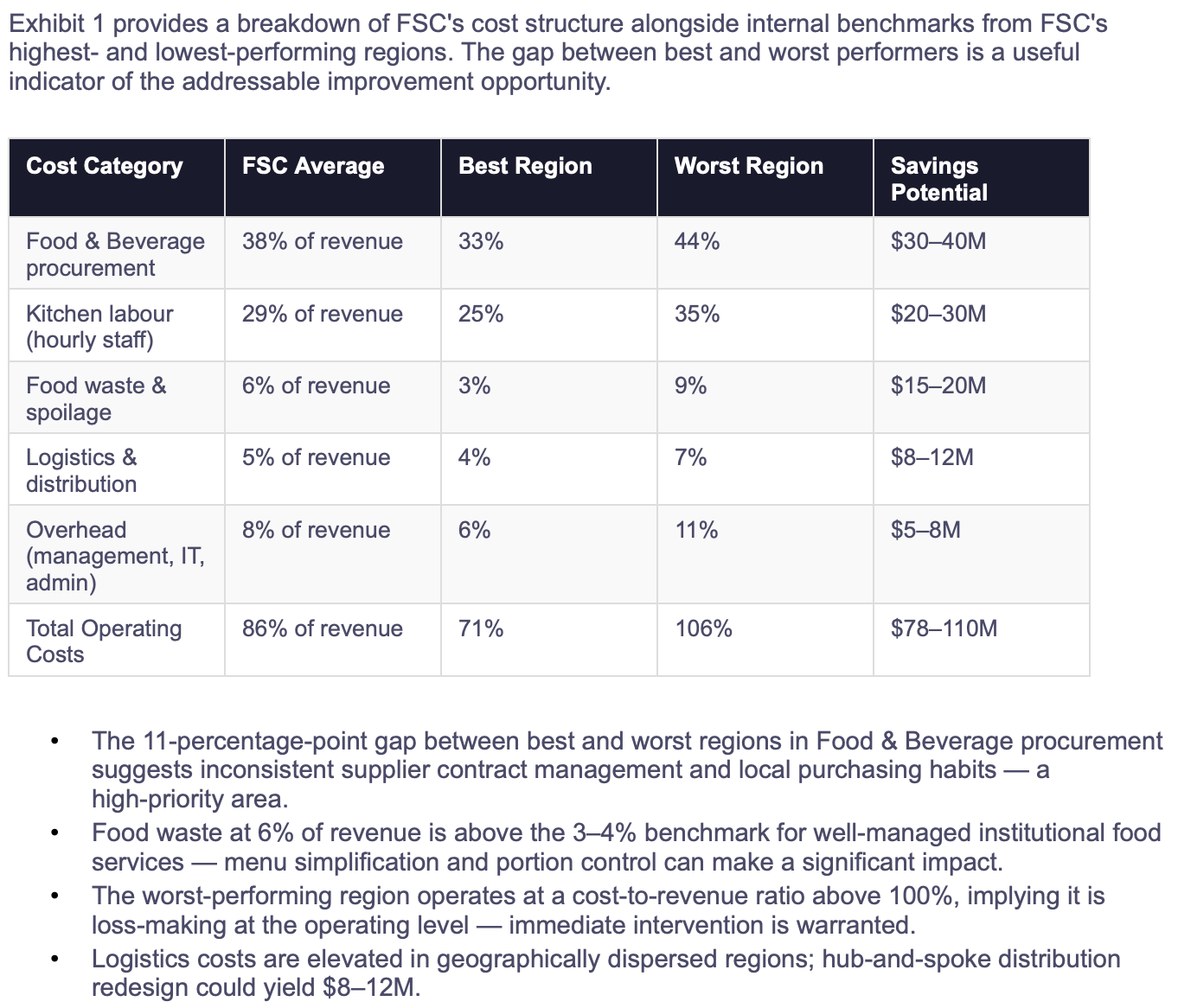
This is a cost reduction case with a supply chain and operations flavour. The recommended approach layers strategic diagnosis with operational detail: Step 1: Decompose the cost base — map all costs into direct (food, labour, waste, logistics) and indirect (overhead) categories, and benchmark each against internal best performers and external peers. Step 2: Identify the "burning platforms" — the data reveals that one or more regions are operating above breakeven; these require immediate stabilisation plans separate from the broader programme. Step 3: Prioritise by impact and speed — rank savings levers by annual value and months-to-capture. Quick wins (e.g., central procurement contracts, menu simplification) should be activated within 90 days. Step 4: Design the procurement transformation — build the case for centralised purchasing with national supplier contracts, leveraging FSC's 2.5M meals/day volume to negotiate 8–12% price reductions. Step 5: Address food waste structurally — implement menu engineering (reduce SKUs by 20–30%), tighten inventory management systems, and introduce portion control standards across all locations. Step 6: Governance and tracking — establish a cost programme management office, with monthly savings reporting by region and category, and executive accountability at the Division President level. A strong recommendation would identify centralised procurement ($30–40M), food waste reduction ($15–20M), and labour scheduling optimisation ($15–20M) as the three primary pillars of the $80M programme — together delivering $60–80M within 18 months. The remaining savings from logistics redesign and overhead reduction would be pursued in a second phase.
Practice Sessions
Note: Accepted practice sessions will be available in your profile under "My Practice Sessions".
Case Materials
Submissions (0)
Be the first to comment on this case.

Practice with AI
Sharpen your skills by practicing this case with our AI-powered consultant.
Practice Sessions
Note: Accepted practice sessions will be available in your profile under "My Practice Sessions".