
Board Game Distributor
Practice with AI
Hone your skills by practicing this case with our AI-powered consultant.
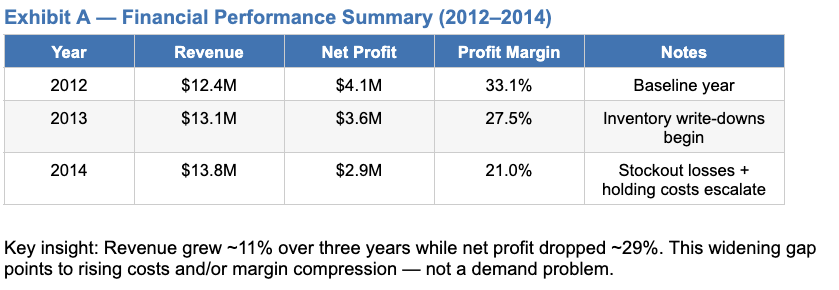
Board Games Company (BGC) has seen profit decline steadily from 2012 to 2014 despite growing revenues, driven by a misalignment between inventory allocation and actual demand across its distribution network. The candidate must diagnose the root causes and recommend an inventory optimization strategy that reduces excess stock in low-demand SKUs while preventing stockouts in high-demand products.
Board Games Company (BGC) is a small but growing distributor of board games operating in the North American market. BGC does not manufacture its own products; it licenses and distributes titles from publishers to a network of retail stores and online channels. The board game industry has experienced a notable resurgence in recent years, with flagship titles such as Settlers of Catan and Monopoly seeing renewed consumer interest. BGC has ridden this wave — revenues have grown each year from 2012 to 2014. However, profitability has moved in the opposite direction, declining steadily over the same period. BGC's operations span: A central warehouse that receives bulk inventory from publishers Five regional distribution hubs serving retail partners across different geographies A product catalogue of approximately 40 active SKUs, ranging from perennial bestsellers to newly released titles A procurement cycle that locks in orders 3–4 months in advance based on historical demand forecasts KPMG has been engaged to identify why profits are falling and recommend actionable improvements to BGC's inventory allocation strategy.
Our client BGC's profits have declined over the last three years (2012–2014) despite revenue growth. We have been hired to diagnose the issue and recommend how BGC should optimize its inventory allocation across its distribution network.
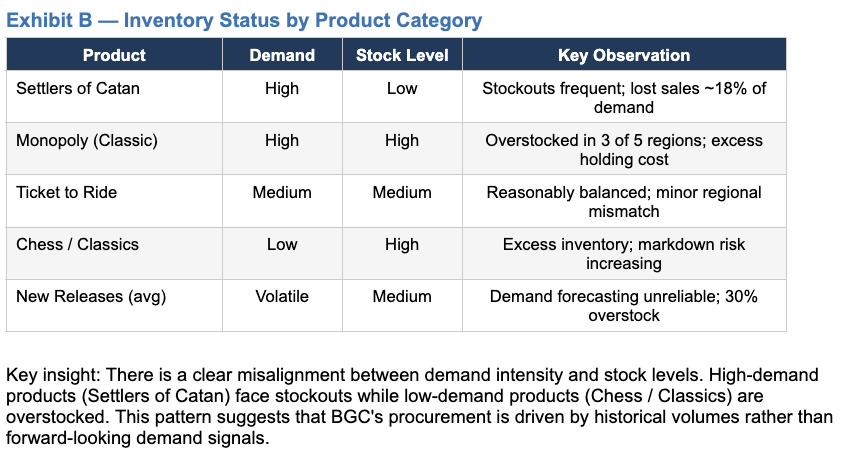
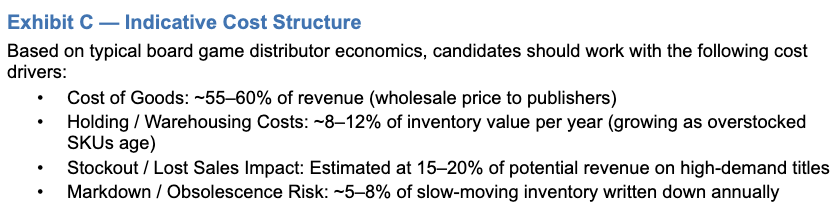
This case is best approached as an Operations Diagnosis → Root Cause → Recommendation structure. Avoid a generic profitability tree — the interviewer wants to see supply chain intuition. Phase 1 — Diagnose Confirm revenue/profit split by SKU and region to pinpoint where losses are concentrated Map current demand forecasting methodology and measure historical forecast accuracy Audit inventory levels vs. reorder points across all 5 regional hubs Identify contractual flexibility with publishers (return rights, consignment options) Phase 2 — Root Cause Primary driver: Demand forecasts are likely backward-looking and don't account for trend acceleration in popular titles or slowdown in legacy SKUs Secondary driver: Inventory allocation across regions is likely proportional (equal split) rather than demand-weighted Contributing factor: Long procurement lead time (3–4 months) amplifies forecast errors Phase 3 — Recommendations Short-term (0–3 months): Implement emergency reallocation: transfer excess stock from over-inventoried regions to high-demand regions Negotiate markdown or return of slowest-moving SKUs with publishers where contractually possible Medium-term (3–9 months): Rebuild forecasting model: SKU-level, region-level, incorporating sell-through velocity and trend data Set demand-weighted safety stock thresholds per SKU per hub (replace uniform allocation logic) Introduce a mid-cycle reorder window at week 6 of the 12-week procurement cycle Long-term (9–18 months): Explore vendor-managed inventory or consignment terms with top 3 publishers for flagship titles Invest in simple inventory management software that integrates regional sell-through data in near real-time SKU rationalization: reduce catalogue from ~40 to ~28 by discontinuing chronically slow-moving titles Expected Impact A well-executed optimization program should deliver: $600K–$900K improvement in annual profit within 12 months (recovery of lost sales + reduction in holding costs + write-down avoidance) Profit margin recovery from ~21% toward the 28–30% range over 18 months Reduction in excess inventory value by 30–40% within the first procurement cycle
Practice Sessions
Note: Accepted practice sessions will be available in your profile under "My Practice Sessions".
Case Materials
Submissions (0)
Be the first to comment on this case.

Practice with AI
Sharpen your skills by practicing this case with our AI-powered consultant.
Practice Sessions
Note: Accepted practice sessions will be available in your profile under "My Practice Sessions".