
Gulf Partners acquiring Acme Packaging
Practice with AI
Hone your skills by practicing this case with our AI-powered consultant.
Gulf Partners, a mid-market private equity firm, is evaluating the acquisition of Acme Packaging, a manufacturer of industrial packaging materials. Bain has been engaged to conduct a commercial due diligence and advise Gulf Partners on whether to proceed with the acquisition at the proposed enterprise value of $450 million, and if so, at what price.
Acme Packaging is a vertically integrated manufacturer of corrugated cardboard, flexible packaging, and specialty industrial wraps, serving customers in the food processing, e-commerce, and pharmaceutical sectors. Acme operates 8 manufacturing plants across the U.S. and generates approximately $380 million in annual revenue with EBITDA margins of 14%. Gulf Partners is targeting a 5-year hold period with an exit via strategic sale or IPO. The proposed acquisition price of $450M implies a purchase multiple of approximately 8.4x EBITDA. Gulf Partners' investment thesis is based on three claims: (1) growing e-commerce tailwinds, (2) Acme's proprietary sustainable packaging technology, and (3) operational improvement potential of 300–500 basis points in EBITDA margin. - Target: Acme Packaging — revenue $380M, EBITDA margin 14% (~$53M EBITDA) - Proposed EV: $450M (8.4x EBITDA) - Hold period: 5 years; exit via strategic sale or IPO - Investment thesis: e-commerce tailwinds + sustainable packaging IP + operational upside - Key sectors served: food processing, e-commerce fulfilment, pharma packaging
Bain must advise Gulf Partners on three interconnected questions to support the acquisition decision: - Is the market thesis credible? Are e-commerce packaging tailwinds durable and is Acme positioned to capture them? - Is the valuation fair? Does the 8.4x EBITDA entry multiple offer adequate return potential given the risk profile? - Is the operational improvement thesis achievable? Can 300–500 bps of EBITDA margin expansion be realised within the hold period? - What are the key downside risks and how significant are they?
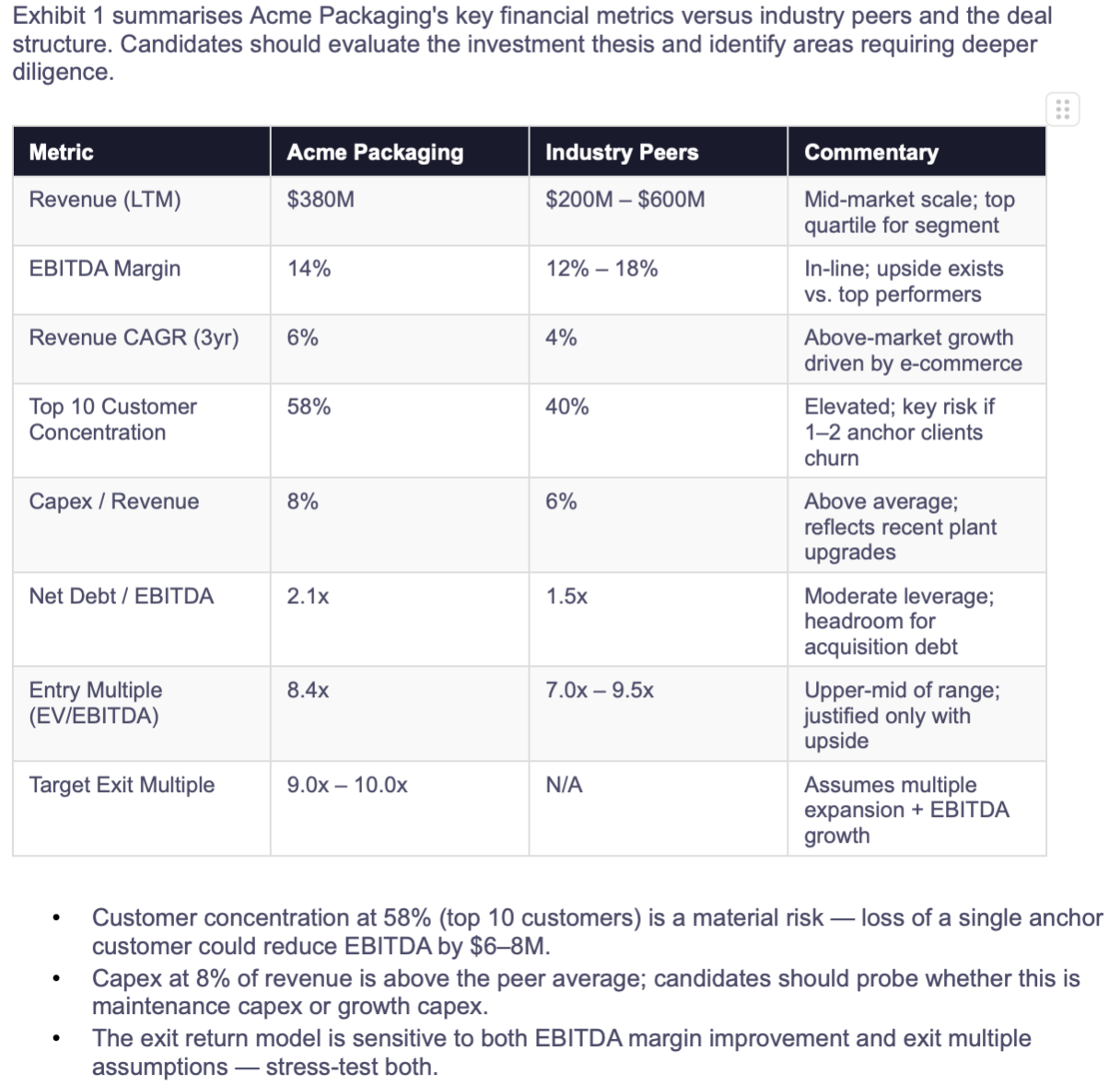
Commercial due diligence for a PE acquisition requires a systematic assessment of the market thesis, competitive position, financial quality, and operational improvement potential. The recommended framework is: Step 1: Validate the market thesis — assess the durability of e-commerce packaging demand, regulatory tailwinds for sustainable packaging, and any structural threats (e.g., direct packaging by e-commerce platforms). Step 2: Assess Acme's competitive position — benchmark against peers on technology differentiation, customer relationships, pricing power, and production cost competitiveness. Step 3: Analyse financial quality — review revenue quality (recurring vs. project-based), customer concentration risk, EBITDA margin bridge, and working capital dynamics. Step 4: Build the returns model — model a 5-year hold period with base / upside / downside cases on revenue growth (3%, 6%, 9%), EBITDA margin (14%, 17%, 19%), and exit multiple (8x, 9x, 10x). Step 5: Evaluate the operational improvement thesis — benchmark Acme's cost structure against best-in-class peers to identify the credible source of the 300–500 bps opportunity. Step 6: Synthesise and recommend — provide a clear go / no-go with a recommended bid range ($420M–$450M base; walk-away at $480M) and key conditions precedent. A strong conclusion acknowledges the credibility of the e-commerce tailwind and the potential for margin improvement, but flags customer concentration as the primary risk. The recommendation should be conditional: proceed at or below $450M if management can demonstrate contractual protections with the top 3 customers, and if an independent operational assessment confirms the margin improvement pathway.
Case Materials

Practice with AI
Sharpen your skills by practicing this case with our AI-powered consultant.