
Chicago Parking Meters
Practice with AI
Hone your skills by practicing this case with our AI-powered consultant.
Parking GenNext, a private operator, is bidding on a 20-year contract to acquire the rights to operate and collect revenue from Chicago's ~40,000 metered parking spaces. The candidate must estimate a reasonable bid price by projecting revenues, costs, and net cash flows over the contract period.
In 2008, the city of Chicago sold the rights to its parking meters for 75 years to a private company for $1.15 billion. This case is a stylized version of that real transaction. Chicago is cash-strapped and looking to monetize its parking infrastructure while offloading operational responsibilities it has historically managed poorly. The city will run a competitive bidding process where the highest bidder wins. Key contextual details: (1) The contract covers approximately 40,000 metered parking spaces across the city. (2) The winning bidder takes on demand risk and absorbs any losses if usage drops. (3) The contract requires a technology upgrade, replacing old coin-only meters with machines that accept cash, credit, and debit cards. (4) Parking ticket revenues remain with the city; the company only collects meter fees.
Your consulting firm has been hired by Parking GenNext to determine a reasonable bid price for the 20-year rights to collect all meter revenue from Chicago's parking spaces. The bid must account for projected revenues, one-time capital investment, ongoing operating costs, and risk to consumer demand.
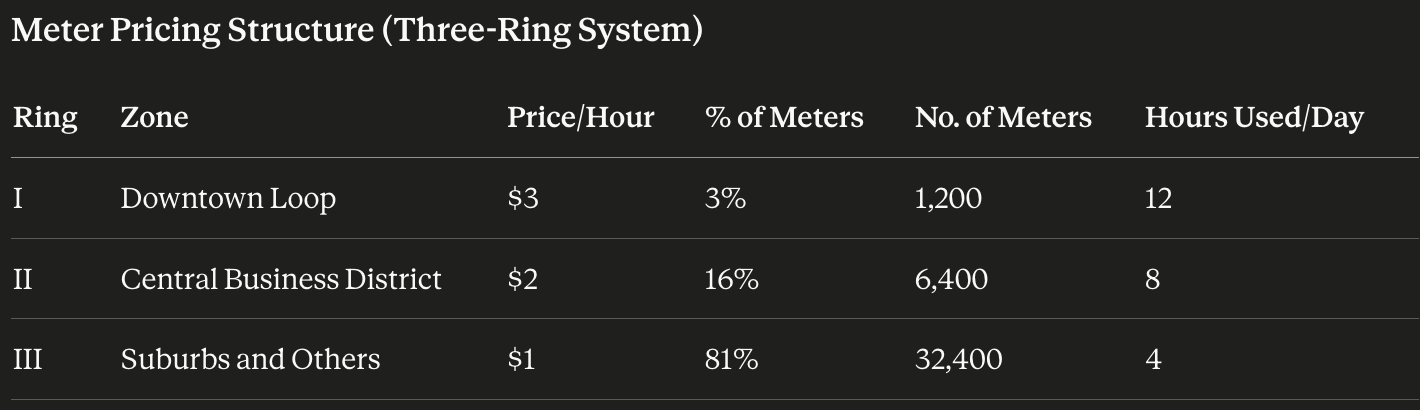
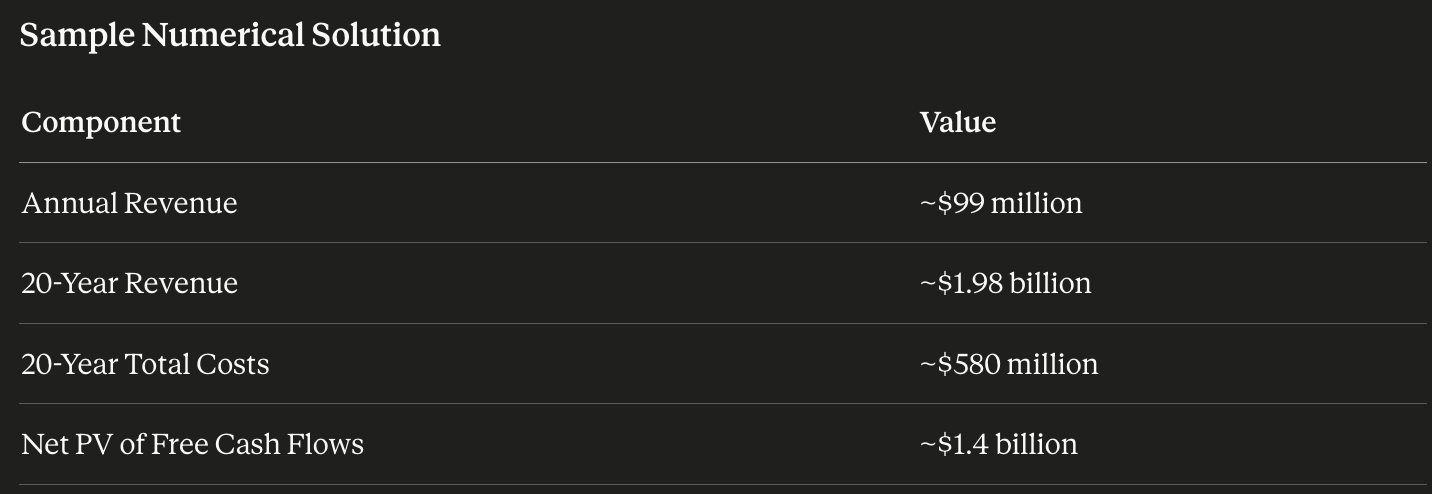
Stage 1: Revenue and Cost Estimation (Quantitative) Structure the analysis as a classic revenue minus cost framework. Start with revenue by segmenting the 40,000 spaces into the three rings, applying price per hour and daily usage hours, then multiplying up to an annual and 20-year figure. With zero growth, 20-year gross revenue lands at approximately $1.98 billion. Move to costs in two buckets: one-time CapEx for meter replacement (approximately $100 million) and recurring OpEx covering labor and maintenance (approximately $24 million per year, or approximately $480 million over 20 years). Total costs come to approximately $580 million. The resulting maximum bid is the NPV of free cash flows before any profit margin, which works out to approximately $1.4 billion. GenNext would bid below this figure to preserve an acceptable return. Stage 2: Risk and Creative Strategy (Qualitative) A strong candidate will proactively raise the time value of money by discounting future cash flows, demand-side risks over a 20-year horizon such as urbanization trends, autonomous vehicles, and modal shift, and revenue upside opportunities such as dynamic pricing, spot reservations, or app-based services. They should also consider the reputational dimension, since public expectations rise when a city service is privatized and GenNext needs a quality assurance strategy from day one.
Practice Sessions
Note: Accepted practice sessions will be available in your profile under "My Practice Sessions".
Case Materials
Submissions (0)
Be the first to comment on this case.

Practice with AI
Sharpen your skills by practicing this case with our AI-powered consultant.
Practice Sessions
Note: Accepted practice sessions will be available in your profile under "My Practice Sessions".