
Salt Lake City Airport
Practice with AI
Hone your skills by practicing this case with our AI-powered consultant.
A consulting firm is preparing to pitch to the President of Salt Lake City International Airport. Before the pitch, the team needs to understand how the airport operates, size its passenger volume, and make a recommendation on which of two capital projects the airport should pursue. This case tests structured thinking, market sizing math, and the ability to make a grounded recommendation using both financial and stakeholder logic.
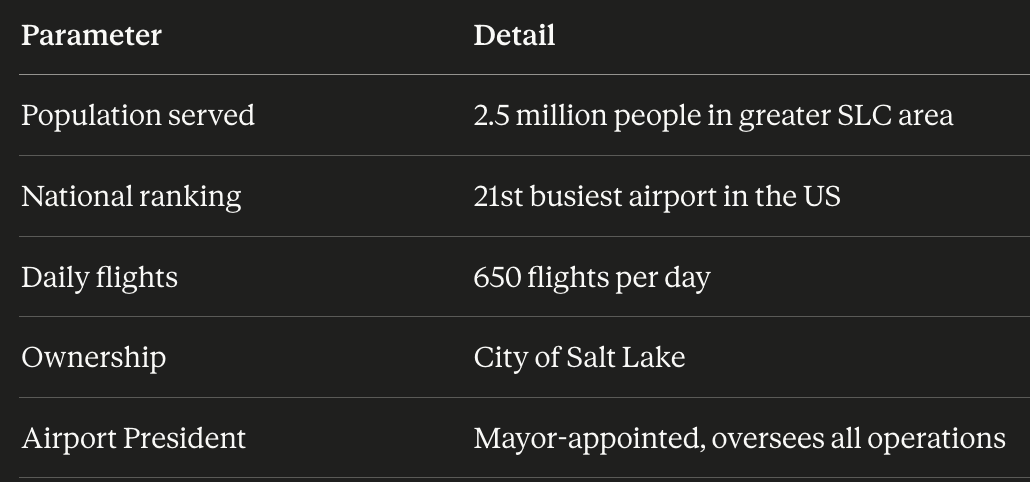
Salt Lake City International Airport is the only commercial airport serving a population of more than 2.5 million people in the greater Salt Lake City area. It ranks as the 21st busiest airport in the US, handling 650 flights per day. The airport is owned entirely by the City of Salt Lake, and its President is a mayoral appointee responsible for overseeing all aspects of airport operations. A consulting firm is pitching for a major contract with the airport. The goal going into the pitch is to demonstrate a strong understanding of how the airport works, who it serves, and what decisions the President is weighing. Casegiver note: This case does not follow a traditional framework structure. Answers should still be organized and logical, math should be clean and correct, and the candidate should take a few seconds to gather their thoughts before responding to each question.
The case is organised around three sequential questions the interviewer poses to the candidate: Part 1: What are the most important priorities the Airport President has to manage? Part 2: How many passengers does SLC Airport handle on an annual basis? Part 3: The airport is considering two capital projects, a sit-down restaurant and a lounge, both already funded through municipal bonds. Which should the President choose? The candidate needs to move through all three parts in a structured, fluent way while connecting their reasoning across the questions.
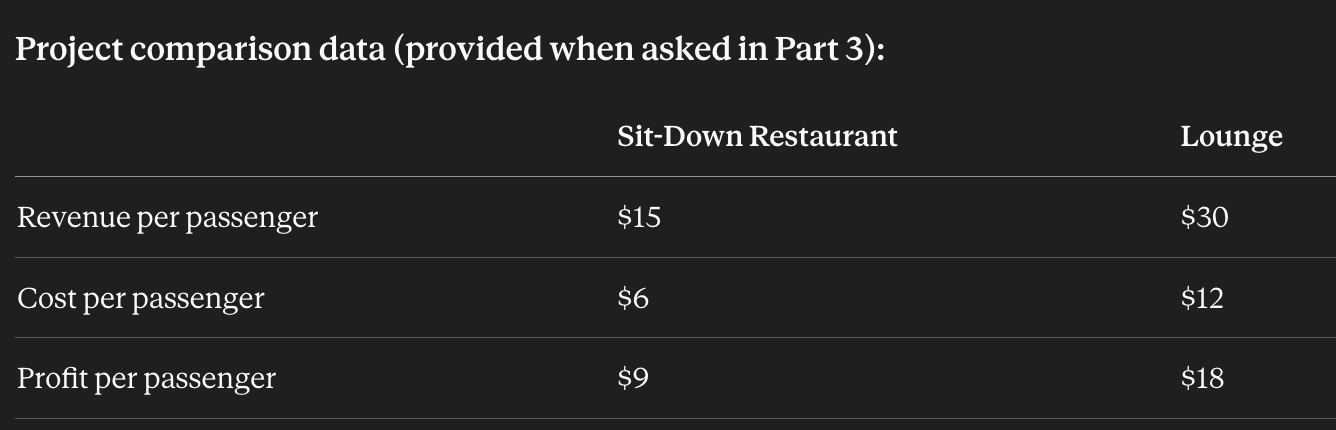
Part 1: Stakeholder framework Structure the answer around three to four key stakeholder groups and explain the ripple effects of getting each one wrong. Passengers are the foundation. A poor passenger experience pushes people toward alternatives like driving or choosing a different destination entirely, which reduces throughput and hurts everything downstream. Airlines are a critical lever. If airlines reduce service to SLC, ticket prices rise, fewer passengers travel, and the local economy takes a hit. The President needs to keep the airport an attractive hub for carriers. Terminal vendors shape the day-to-day passenger experience and represent local employment. The President functions like a mall operator here, balancing tenant mix, foot traffic, and lease terms. Secondary considerations worth naming include the city government (since the airport is publicly owned and politically accountable), tourism bodies, and security operations. Part 2: Passenger sizing Use the flight-based method for speed and clarity: 365 days x 650 flights x 180 seats x 75% occupancy = approximately 32 to 34 million passengers per year State your assumptions before calculating. Round sensibly. The exact number matters less than the approach being logical and the math being clean. Part 3: Project recommendation Start with the financials. The restaurant earns $9 of profit per passenger and the lounge earns $18. Both are profitable, so the better option on a per-passenger basis is the lounge, unless the restaurant draws more than twice the foot traffic, which is unlikely in an airport context. Then layer in the stakeholder reasoning from Part 1. SLC is a major hub and the majority of its passengers are business travelers. That segment strongly prefers a lounge over a casual sit-down meal. Additionally, the airport almost certainly has some counter-service or grab-and-go food vendors already operating. A sit-down restaurant would pull spending away from those vendors and create friction. A lounge does not compete with them in the same way. Recommendation: open the lounge. It generates higher profit per guest, better serves the dominant passenger segment, and avoids cannibalizing existing food vendors in the terminal.
Practice Sessions
Note: Accepted practice sessions will be available in your profile under "My Practice Sessions".
Case Materials
Submissions (0)
Be the first to comment on this case.

Practice with AI
Sharpen your skills by practicing this case with our AI-powered consultant.
Practice Sessions
Note: Accepted practice sessions will be available in your profile under "My Practice Sessions".