
Unicloth
Practice with AI
Hone your skills by practicing this case with our AI-powered consultant.
Unicloth is an Asian clothing retailer that has been operating in the United States for five years without achieving profitability. The company has four stores across the country and is losing money despite operating in a stable retail market with pricing broadly in line with mid-tier competitors. The case works through a revenue build, a detailed cost breakdown, and a profitability improvement analysis to identify what is going wrong and what the company should do about it.
Unicloth sells casual clothing including jeans, t-shirts, knit sweaters, and dresses. The designs follow the company's home market aesthetic from Asia, and all manufacturing takes place in China and Bangladesh. The US retail market has been stable throughout the five years of operation, with no meaningful economic downturns or unusual competitive dynamics. Unicloth's US footprint consists of four stores: three mall locations and one flagship store on 5th Avenue in New York. Pricing sits at an average of around $40 per item, which is broadly in line with mid-tier American competitors and slightly below some European rivals operating in the same space. Despite five years of trading, the company has not reached profitability and has hired the consulting firm to diagnose the problem and recommend a path forward.
Unicloth is generating $125 million in annual revenue but spending $138 million to operate, leaving the business $13 million in the red each year. The core questions are: why is the cost structure so heavy relative to revenue, and what specific actions can close the gap and get the business to profitability? Two underlying issues emerge through the case. On the cost side, the business is carrying significant fixed costs in rent and COGS that are not yet covered by its revenue base. On the revenue side, a product-market fit problem is hiding in plain sight: American consumers find the styles too conservative, the colors too muted, and the sizing too small, which suppresses both conversion and repeat purchasing.
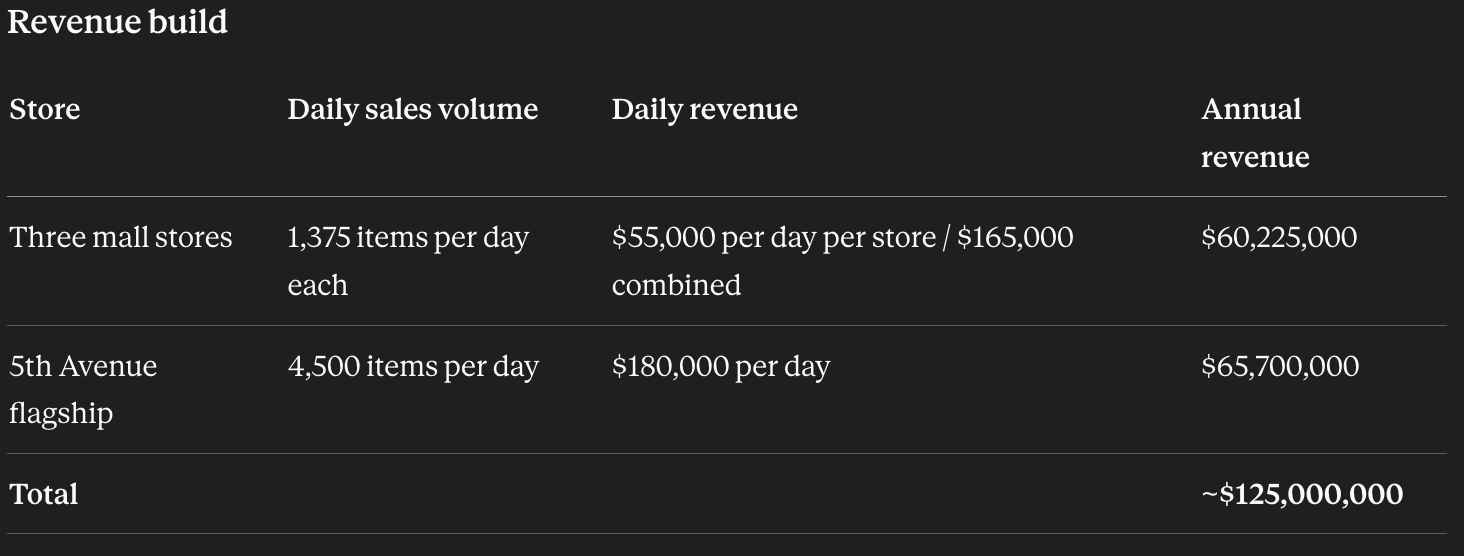
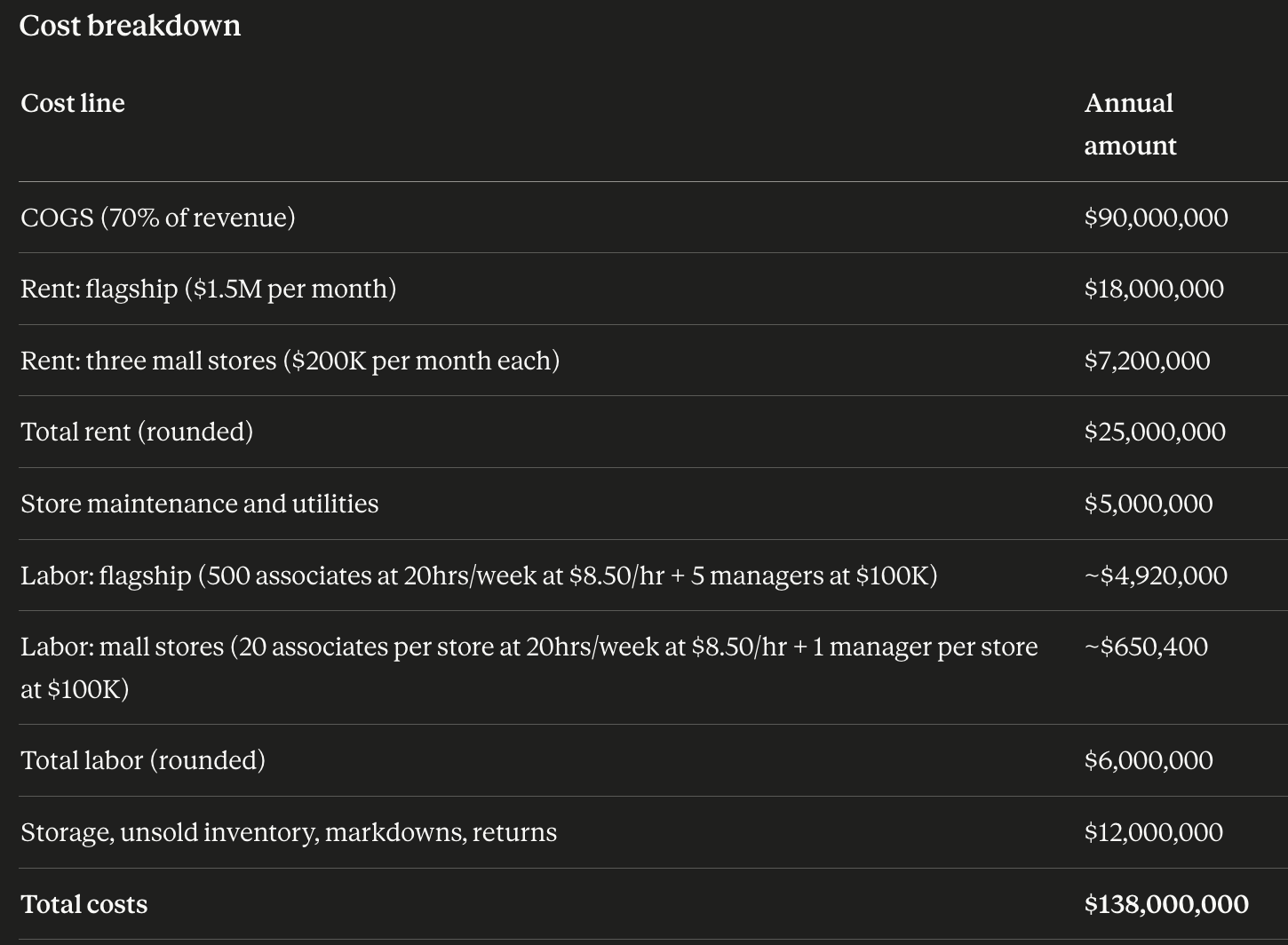
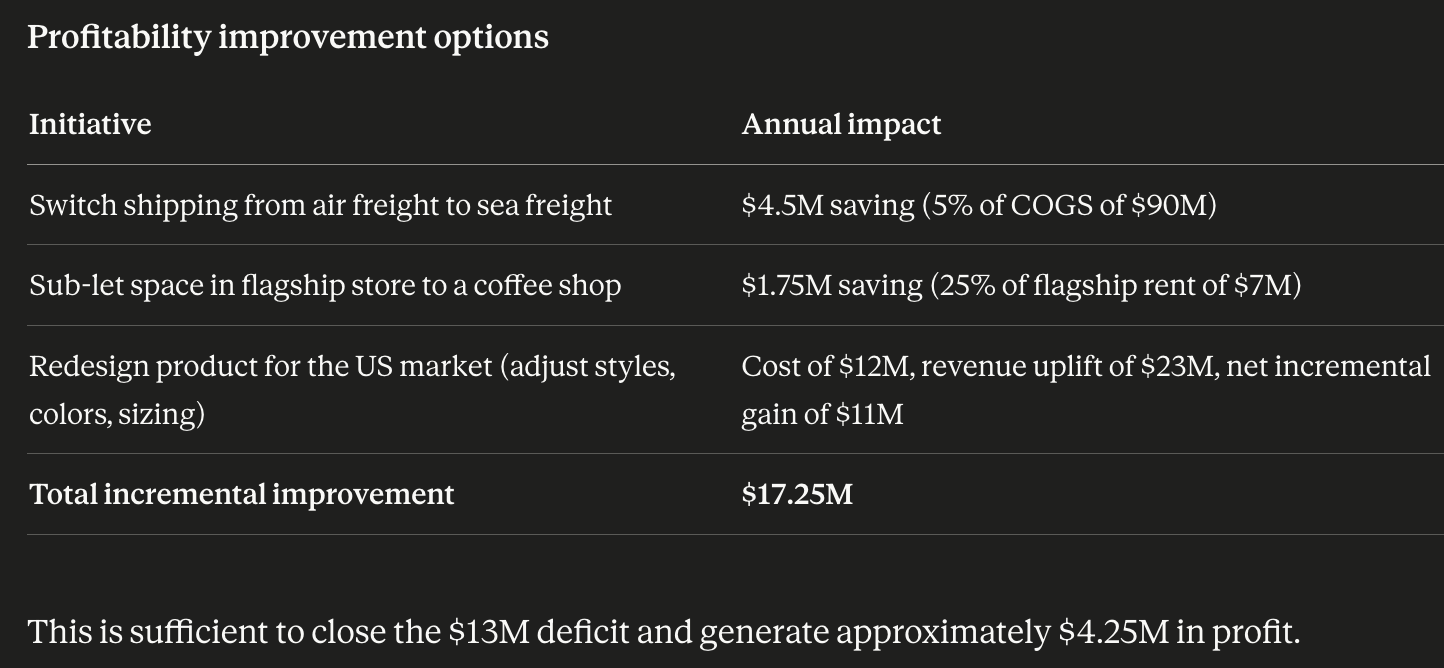
This is a profitability case with a product-market fit twist. The structure is more guided than a typical open-ended case, with data provided at each stage. The candidate's job is to build cleanly through revenue, costs, and then improvements in a logical sequence. Revenue build Start with the store footprint and work from daily unit sales to annual revenue. The three mall stores contribute roughly $60 million and the flagship adds about $66 million, giving a working figure of $125 million. The math is straightforward but the candidate should show the working clearly: items per day times price times days per year. Cost identification Before being given the numbers, the candidate should brainstorm the cost categories independently. A strong answer covers COGS, rent (broken out by store type), labor (broken out by store and role), maintenance and utilities, and the often-overlooked cost of unsold inventory, markdowns, and returns. That last category carries $12 million per year in this case and is a meaningful signal of product-market fit problems. The total cost of $138 million versus $125 million in revenue means the business is $13 million in the red. That is the problem to solve. Profitability improvement On the cost side, the two available levers are shipping and rent. Switching from air freight to sea freight saves 5% of COGS, which at $90 million equates to $4.5 million annually. The tradeoff is longer lead times, which creates inventory management risk. On rent, closing stores or moving the flagship are ruled out, but sub-letting space within the flagship to a coffee shop or similar retail partner saves 25% of the flagship rent, which is $1.75 million per year. This also has the potential secondary benefit of increasing dwell time and conversion. On the revenue side, the core insight the candidate needs to surface is that the product itself is not right for the American market. The styles are too conservative, the colors too muted, and the sizing runs small relative to American body proportions. This is the root cause of the underperformance and it is not fixed by pricing, staffing, or marketing. Redesigning and manufacturing a US-specific product line costs $12 million per year but generates $23 million in incremental revenue, a net gain of $11 million. The three measures together generate $17.25 million in improvement, which more than closes the $13 million deficit and puts the business around $4.25 million into profit. Final recommendation Unicloth is losing $13 million per year primarily because its cost base is too heavy for its current revenue and because its product is not well matched to American consumer tastes. Three actions together close the gap and move the business into profit: switch shipping to sea freight for $4.5 million in annual savings, partner with a coffee shop or similar operator at the flagship to share rent costs and save $1.75 million, and invest in redesigning the product range for the US market to better fit local style preferences and sizing norms, generating $11 million in net incremental revenue. The key risks to flag are the reliability of the sub-letting partner, the possibility that even redesigned products fail to resonate with American consumers, and the impact of longer sea freight lead times on stock availability. Mitigations are a careful partner selection process for the in-store tenant, consumer research to validate the new designs before full-scale production, and a review of US warehouse operations and lead time planning to compensate for the slower shipping route.
Practice Sessions
Note: Accepted practice sessions will be available in your profile under "My Practice Sessions".
Case Materials
Submissions (0)
Be the first to comment on this case.

Practice with AI
Sharpen your skills by practicing this case with our AI-powered consultant.
Practice Sessions
Note: Accepted practice sessions will be available in your profile under "My Practice Sessions".