Medical Supply Chain

Medium
Transportation
Operational Improvement
Public View

Practice with AI

Hone your skills by practicing this case with our AI-powered consultant.

This case requires the candidate to evaluate two supply chain distribution plans and recommend the best option for the client. This will involve understanding of supply chain costs and intense quantitative analysis.

The client is a $2.5B Fortune 500 worldwide provider of transportation, logistics, and supply chain management solutions. Its product offerings include: • LM: Leasing and programmed maintenance of trucks, tractors, and trailers to commercial customers • SC: Manages the movement of materials and related information from raw materials to delivery • DCC: Turn-key transportation service including vehicles, drivers, routing, and scheduling The focus of the engagement is the LM group. Truck registrations are growing at only 2.2% CAGR, and the LM market is declining. However, the client's LM revenues have remained flat, suggesting survival through acquisitions rather than organic growth. The client seeks significant growth over the next 2 years.

How can the client achieve significant organic growth in its LM business over the next 2 years, given that its core market is declining and its product offering is undifferentiated?
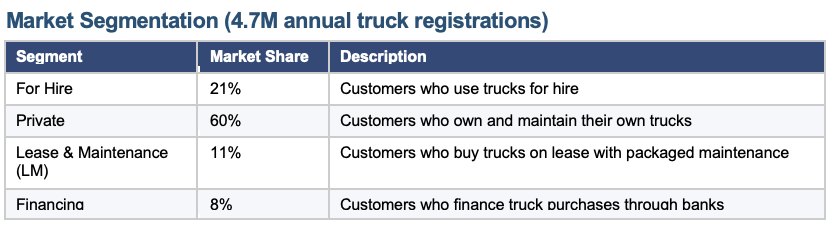
Competitive Landscape • Client holds 24% of the LM market • One competitor also holds 24% of the LM market • Remaining 50% held by smaller players • Product offerings are highly undifferentiated — asset (truck) + mandatory maintenance program
Exhibit 1Exhibit 2
Q1: What are the different ways to achieve organic growth?
Recommended approach:
• Current products to current customers — reduce prices
• New products to current customers — cross-sell
• Current products to new customers — market expansion
• New products to new customers — new segment penetration
Q2: What is the current market dynamic and what organic growth strategy do you recommend?
Recommended approach:
• The LM market is declining but truck registrations overall are growing — this means another segment is gaining share
• That growing segment is Private (60% of market). Private customers (grocery chains, retail outlets) own their trucks but outsourcing maintenance is attractive as it is not their core competency
• Strategy: Introduce a maintenance-only product (no asset) targeted at private fleet owners — this is a new product for a new customer segment (penetration)
• The new maintenance-only product will likely be priced lower than the full LM bundle
Q3: What are the key challenges in launching a lower-priced maintenance-only product?
Recommended approach:
• Cannibalization risk — existing LM customers may defect to the lower-priced maintenance-only product
• Service differentiation — client may be unable to differentiate service levels between customer types, leading to over-servicing
Q4: How would you develop the product offering for private customers?
Recommended approach:
• Qualitative Assessment: Customer interviews, focus groups, expert brainstorming to understand private customer needs
• Hypothesis formulation: Define product attributes (service levels, priority servicing, geographic coverage)
• Quantitative Analysis: Conduct representative survey across private customer industries (construction, grocery, utilities, etc.)
• Capability Assessment: Can existing infrastructure support new product? Cost of investment? Cultural readiness?
• Business Case: Quantify revenue potential using estimated pricing and volumes from survey
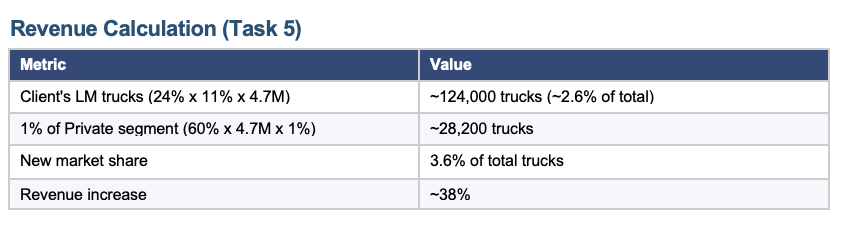
Q5: If the client captures 1% of the private market, by how much do overall revenues increase?
Calculation
Step Calculation Result
Current client trucks 24% x 11% x 4.7M ~124,000 trucks (2.6% of total)
1% of private segment 1% x 60% x 4.7M ~28,200 new trucks
New total trucks 124,000 + 28,200 ~152,200 trucks (3.6% of total)
Revenue increase (3.6% - 2.6%) / 2.6% ~38%

This is a market penetration case. The ideal response framework: • Step 1 — Diagnose the market: understand why LM is declining (product commoditization, not demand decline) • Step 2 — Identify growth vectors: use a 2x2 Ansoff matrix (products x customers) to surface options • Step 3 — Size the opportunity: quantify the private segment and calculate revenue uplift • Step 4 — Address risks: cannibalization and service-level differentiation are the two key concerns • Step 5 — Recommend: new maintenance-only product targeting private fleet operators, with product development following qualitative → quantitative → capability → business case sequence

Practice Sessions

No practice sessions have been proposed yet. Be the first to propose one!

Note: Accepted practice sessions will be available in your profile under "My Practice Sessions".

Case Materials

Submissions (0)

Sort by:

Be the first to comment on this case.

Published July 17, 2025 • 52 views
Firm/University: Kearney
No ratings yet
0