
National Zoo Dilemma
Practice with AI
Hone your skills by practicing this case with our AI-powered consultant.
The Smithsonian's National Zoo in Washington, D.C. is considering acquiring two giant pandas from China to boost visitor numbers and increase revenue. As a non-profit institution funded through a mix of admissions, donations, and federal support, the Zoo must weigh the significant upfront and recurring costs of a panda acquisition against projected financial and reputational benefits. The case challenges the candidate to think through both the quantitative investment logic and the qualitative strategic considerations unique to a non-profit zoo — including conservation mission, diplomatic context, and public engagement.
Client: Smithsonian's National Zoo, Washington, D.C. Organization type: Non-profit institution operating under the Smithsonian Institution Admission: Free to the public (funded through federal appropriations, donations, and ancillary revenue) Context: The National Zoo has a long history with giant pandas, beginning in 1972 when China gifted two pandas — Ling-Ling and Hsing-Hsing — following President Nixon's landmark visit to China. Since the mid-1980s, China shifted from gifting to loaning pandas, with recipient zoos typically paying an annual fee of approximately $1 million per pair. The National Zoo most recently hosted pandas Mei Xiang, Tian Tian, and cub Xiao Qi Ji until November 2023, when rising US-China tensions led to the animals being returned as the loan agreement expired. The zoo then saw a reported 20% decline in visitors in 2024. As diplomatic relations between the US and China have since warmed, the Zoo is now evaluating whether to bring two new pandas on a long-term loan agreement. Panda Diplomacy Context: China retains ownership of all giant pandas worldwide. Zoos negotiate loan agreements with the China Wildlife Conservation Association (CWCA), committing to conservation research partnerships, care standards, and annual loan fees. There are estimated to be fewer than 2,000 giant pandas in the wild and approximately 420 in captivity globally, mostly in China.
Should the National Zoo acquire two giant pandas from China, and if so, under what terms? What will be the financial and strategic impact on the Zoo's revenues, costs, and mission?
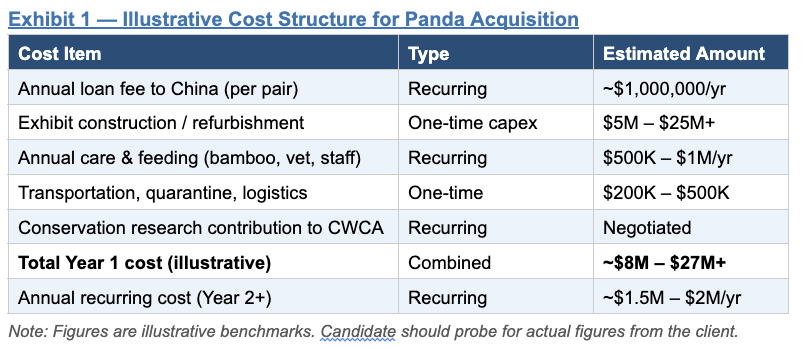
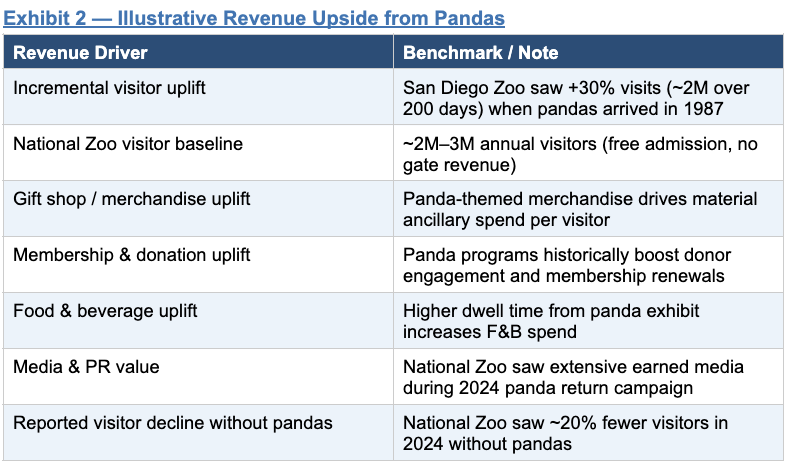
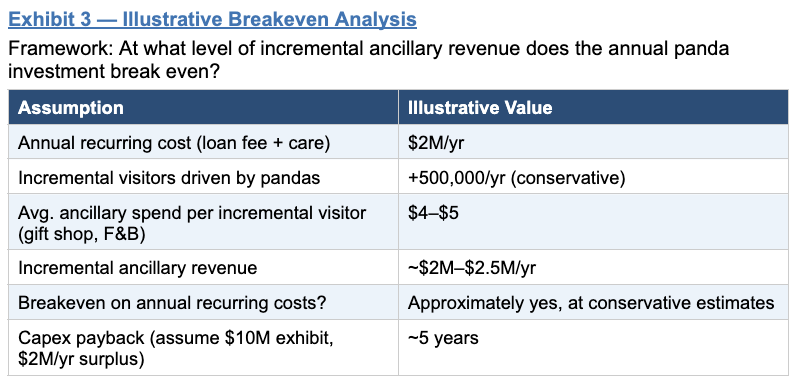
Framework: Investment Decision for a Non-Profit Unlike a for-profit case, the evaluation here must balance financial sustainability with mission advancement. Structure the analysis in three lenses: Financial lens: Can the Zoo cover costs through incremental revenue? What is the breakeven timeline? Mission lens: Does the panda program advance conservation, education, and public engagement goals? Risk lens: What are the operational, geopolitical, and reputational risks — and are they manageable? Step 1 — Quantify the Investment Build a full cost picture: loan fees (~$1M/yr), annual care (~$1M/yr), capex for exhibit construction Estimate incremental visitor uplift using benchmarks (e.g., San Diego Zoo's 30% jump, National Zoo's own prior panda period) Model ancillary revenue per incremental visitor across gift shop, F&B, and membership channels Run a breakeven analysis: at what visitor uplift do annual revenues cover annual panda costs? Step 2 — Evaluate Non-Financial Value Conservation research: panda loans come with obligations but also unique scientific access — valuable for the Zoo's CWCA research partnership Donor activation: high-profile panda programs have historically unlocked major philanthropic support (e.g., the $10M David Rubenstein donation in 2024) National identity & media value: the National Zoo's panda program carries significant public affairs and diplomatic significance that other exhibits do not Step 3 — Assess Risks and Negotiate Terms Geopolitical risk: negotiate exit provisions or reduced fees in case of loan recall due to diplomatic shifts Funding structure: pursue donor capital to fund exhibit capex before committing to the agreement Conservation reciprocity: propose meaningful research collaboration to strengthen the CWCA relationship and justify terms Alternatives considered: compare panda ROI to other marquee animal investments (e.g., African elephants, big cats) to ensure optimal capital allocation Recommendation Summary Yes — the National Zoo should proceed with acquiring two giant pandas under a long-term loan agreement, subject to three conditions: Financial sustainability confirmed: incremental visitor and ancillary revenue should be modeled to cover annual recurring costs of ~$2M; historical data strongly suggests this is achievable Exhibit capital secured through donors before construction begins, avoiding operational budget strain Loan terms negotiated with appropriate exit protections and conservation research provisions to align with the Zoo's mission and mitigate geopolitical risk
Practice Sessions
Note: Accepted practice sessions will be available in your profile under "My Practice Sessions".
Case Materials
Submissions (0)
Be the first to comment on this case.

Practice with AI
Sharpen your skills by practicing this case with our AI-powered consultant.
Practice Sessions
Note: Accepted practice sessions will be available in your profile under "My Practice Sessions".