
Pharma Company Outsourcing
Practice with AI
Hone your skills by practicing this case with our AI-powered consultant.
Waltham&Rose, a US-based pharmaceutical company, is embarking on its first international expansion into Germany and France, which will grow its headcount by 50%. Simultaneously, the company is planning to outsource health benefits management for the first time and roll out a cloud-based CRM system across its entire workforce, many of whom are long-tenured and not accustomed to significant change. Deloitte Human Capital has been brought in to design a smooth CRM adoption process and ensure the new European employees feel genuinely connected to the Waltham&Rose brand. This case tests a candidate's ability to manage multiple overlapping people challenges in a fast-moving, high-stakes context.
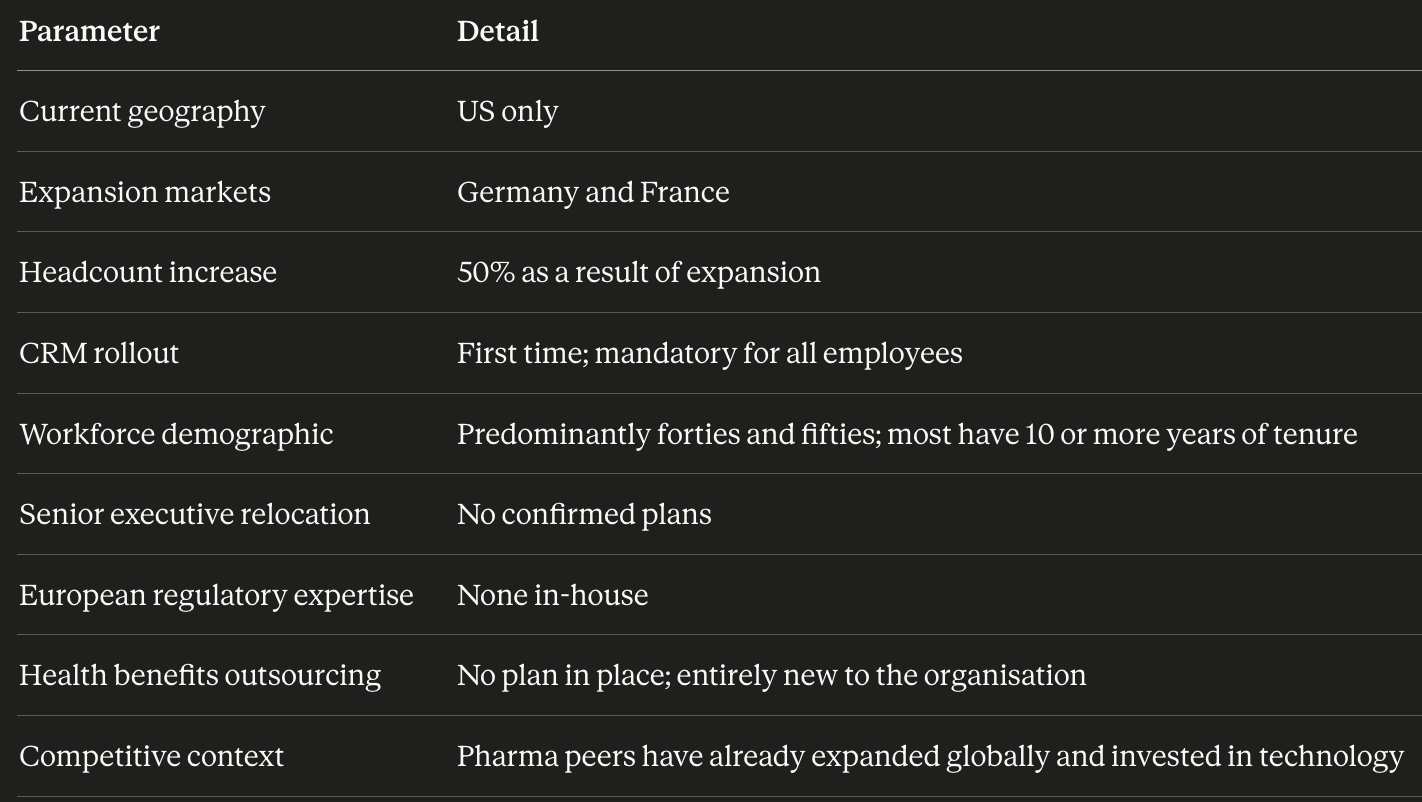
Waltham&Rose has operated solely within the US for its entire history. The company is now expanding into Germany and France, increasing its total workforce by 50% as a result. Three major initiatives are being executed simultaneously: The international expansion itself, which will see Waltham&Rose hiring a significant number of new employees in two countries with very different regulatory, cultural, and employment environments compared to the US. The outsourcing of health benefits management, which is entirely new territory for the company. No plan is currently in place for how this will work, and no prior outsourcing experience exists internally. The mandatory rollout of a cloud-based CRM platform to all employees globally, including a workforce that is predominantly in its forties and fifties, most of whom have been with the company for at least a decade and have not previously used this type of technology. The broader pharma industry context is relevant: competitors have already moved ahead on both global expansion and technology, which means Waltham&Rose executives feel significant time pressure to execute all three changes quickly. Additional context from the case: No senior executive has a confirmed plan to relocate to Europe, which creates a leadership gap in the new offices. The company has no in-house expertise in European business regulations. The workforce is predominantly middle-aged and long-tenured. Outsourcing is entirely new to the organisation.
Waltham&Rose faces three simultaneous people and organisational challenges, each of which would be complex on its own: International expansion and cultural integration: New European employees need to feel part of the Waltham&Rose family and be able to represent the brand authentically, despite operating thousands of miles from headquarters in countries with their own employment laws, languages, and cultural norms. CRM technology adoption: A mandatory new platform is being introduced to a workforce with limited technology change experience. The risk of low adoption, workarounds, and employee frustration is significant if the rollout is handled poorly. Health benefits outsourcing: The company is transitioning this function to an external provider for the first time, with no plan in place and no precedent to draw on internally. Employees in both the US and Europe will be affected, and healthcare regulations differ substantially across the three countries. All three challenges must be managed at pace, given competitive pressure from peers who have already made these transitions.
This is a Human Capital case with three distinct but interconnected challenges. There are no numbers to crunch. The value a candidate adds comes from showing they can hold multiple threads at once, prioritise intelligently under time pressure, and tailor recommendations to the specific context of this workforce. Business issues to state clearly at the outset: Waltham&Rose is asking Deloitte Human Capital to help it manage a simultaneous international expansion, a first-time outsourcing of benefits, and a company-wide technology rollout, all against a backdrop of a long-tenured, change-averse workforce and real competitive urgency. Work Stream 1: Organisational Design and Job Redesign (highest priority) The company is growing by 50% and entering markets it has never operated in before. Before anything else, it needs to understand what roles exist, what roles need to be created, and who should fill them. Assess: Conduct a skills gap analysis to understand what capabilities Waltham&Rose currently has versus what the expanded organisation will need. Run a change readiness assessment across the existing workforce. Given the time pressure, gather this information through an accelerated approach such as a half-day all-hands workshop rather than a lengthy survey process. Implement: Use competency modelling to define what the new version of Waltham&Rose needs from its people. Update job descriptions to reflect new realities. Create the new roles the expansion requires, which at minimum should include an Outsourcing Manager to own the benefits transition, a CRM Manager to lead adoption, and an International Compliance Manager to navigate German and French employment law. Decide on the right mix of internal promotions versus external hires for each role. On the European leadership question, it is strongly advisable to have at least one senior US executive relocate to each new office for the medium term to maintain culture and coherence, paired with senior local hires in Germany and France who bring language, regulatory knowledge, and cultural fluency. Evaluate: Track progress against the hiring and onboarding timeline. Measure individual performance against the newly defined role expectations. Work Stream 2: Training and Learning The CRM rollout is the most visible immediate risk to day-to-day productivity. A workforce that is largely in its forties and fifties, with little prior experience of major technology transitions, needs a training approach that is genuinely suited to how they learn, not a generic one-size-fits-all programme. Assess: Understand what training infrastructure already exists at Waltham&Rose and whether it is fit for purpose. Conduct a stakeholder analysis to identify the different learning personas within the workforce. The US employees, many of whom are older and longer-tenured, will have different needs from newly hired European employees who are joining a new company and learning its systems from scratch. Implement: Design a training and learning strategy that uses multiple content formats, including video for self-paced review, nano-learning tools for bite-sized reinforcement, and classroom or workshop formats for those who learn better with peers. Rationalise any existing training content to remove duplication. Integrate a rewards element into the training strategy to incentivise completion and recognise progress. Pilot the programme with a subset of users before the full global rollout, so issues can be identified and fixed without disrupting the whole organisation. Evaluate: Measure adoption rates, pace of learning, knowledge retention scores, and user feedback. Training and learning are a direct lever on employee engagement, which in turn drives productivity and retention. The case raises an important objection worth addressing directly: if Waltham&Rose pushes back on training investment, the response is that a CRM system no one uses effectively is more expensive than the training itself. The cost of failed adoption, lost data, workarounds, and re-implementation dwarfs the cost of doing training properly. Work Stream 3: Technology Adoption and Benefits Outsourcing These two changes affect every employee and carry the highest risk of triggering anxiety if handled poorly. Assess: Conduct a technology impact assessment. Determine whether the CRM platform will be accessible outside the office network, which matters for field-based pharma employees. Assess the data migration costs and complexity for both the CRM and the healthcare systems. Run a stakeholder analysis to understand who will be most affected by each change and where the greatest pockets of resistance are likely to sit. Proactively ask how employees are reacting to the announced changes, rather than waiting for problems to surface. On the outsourcing side: Waltham&Rose needs to understand that healthcare regulations in the US, Germany, and France are substantially different. A single outsourcing partner is unlikely to cover all three jurisdictions adequately. Multiple partners may be required, and the procurement and vendor management work needed to select and onboard them is itself a significant project. Employees get anxious when benefits changes are unclear, and that anxiety shows up in performance. Clear, consistent communication about what is changing, when it is changing, and how to access the new benefits provider is not optional. Implement: Build a technology adoption strategy with a clear transition plan and a contingency plan for when things go wrong. Communication to employees should be consistent, honest about the timeline, and explicit about what the changes mean for them personally. For the benefits outsourcing, make it as easy as possible for employees to reach the new provider, with clear contact details and a simple process. Evaluate: Measure employee acceptance of the CRM and benefits changes separately. Track CRM usage rates and reductions in manual workarounds as indicators of genuine adoption. Track cost savings as the outsourcing matures. Set clear milestones against which progress can be reported back to Waltham&Rose leadership. Other considerations to flag: Dependencies between work streams matter here. The organisational design work needs to happen first because the new roles, particularly the Outsourcing Manager and CRM Manager, are necessary to lead the other two streams. Trying to run all three work streams simultaneously without those roles filled is likely to result in coordination failures. Relevant human capital trends to weave in: the generational divide in technology adoption, the increasing complexity of managing multi-jurisdiction employment and benefits compliance, leadership succession planning as the company internationalises for the first time, and the risk that a culture built around decades of US-only operation does not automatically travel well across borders without deliberate effort.
Practice Sessions
Note: Accepted practice sessions will be available in your profile under "My Practice Sessions".
Case Materials
Submissions (0)
Be the first to comment on this case.

Practice with AI
Sharpen your skills by practicing this case with our AI-powered consultant.
Practice Sessions
Note: Accepted practice sessions will be available in your profile under "My Practice Sessions".