
Made to Measure
Practice with AI
Hone your skills by practicing this case with our AI-powered consultant.
Our client owns a designer shoe-store that makes high end made-to-measure shoes for customers. The high-quality product has gained popularity rapidly and the client wants to ramp up production. However, the highly-skilled labor that our client employs is hard to come by. Our client wants us to help them figure out how to increase output without adversely affecting quality and the company’s potential profitability.
Our client owns a designer shoe-store that makes high end made-to-measure shoes for customers. The high-quality product has gained popularity rapidly and the client wants to ramp up production. However, the highly-skilled labor that our client employs is hard to come by. Our client wants us to help them figure out how to increase output without adversely affecting quality and the company’s potential profitability.
• There are no additional skilled shoemakers available in the market • The shoe-making process has 3 stages, cutting, stitching and finishing • Currently there are 15 workers, each of whom take an average of 12 hours to produce one pair of shoes • Each shoemaker performs all three steps of the process under the current system
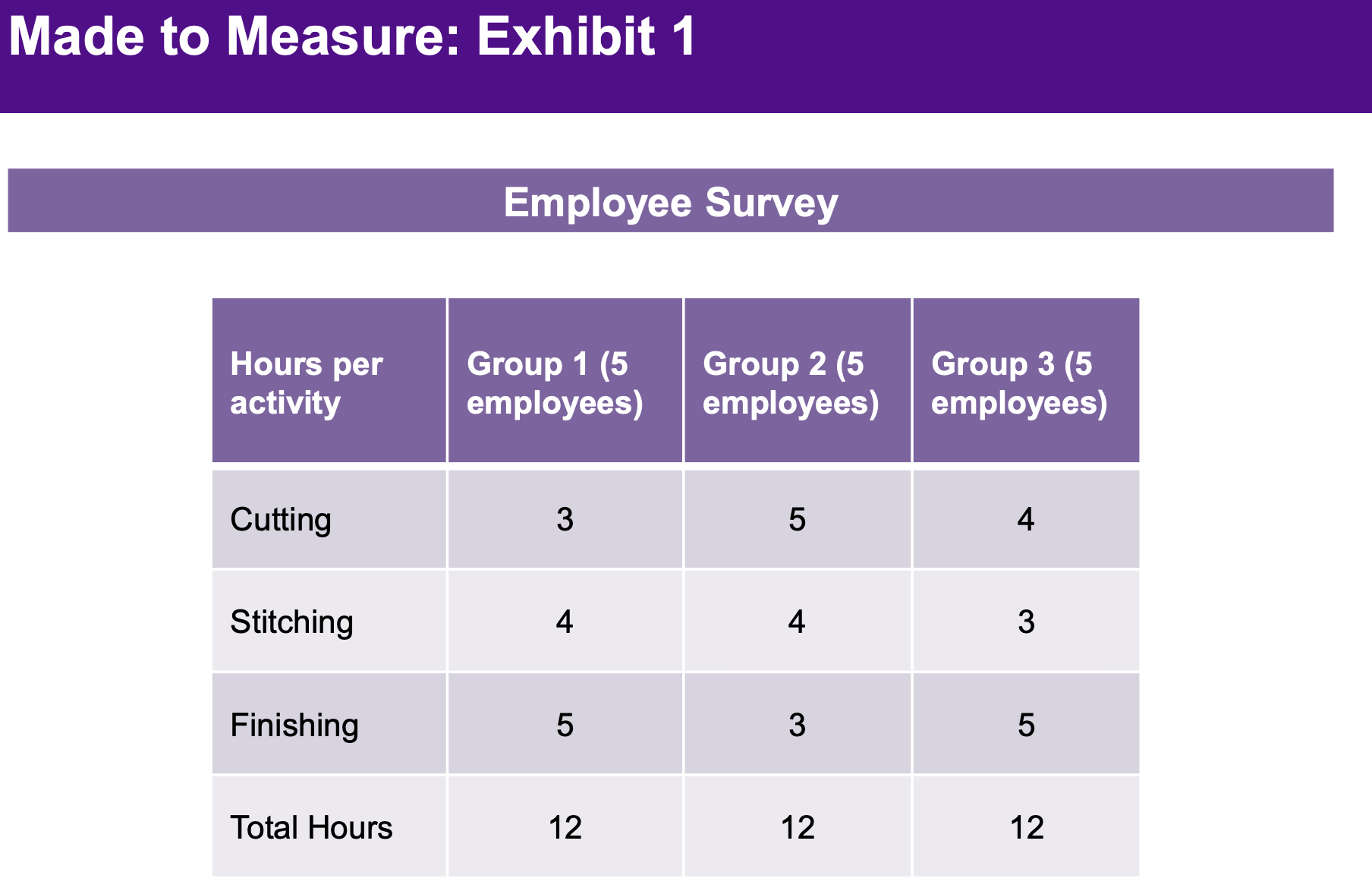
Opening framework should explore two dimensions: the production process (stages involved, time per stage, current labor allocation) and the cost/profitability structure (revenue per pair, COGS, labor, fixed costs). The candidate should resist jumping to external solutions like new hires or technology — the interviewer will redirect if needed. For the operations insight, the critical question to ask is whether workers can be assigned to specific tasks rather than performing all three. Once the exhibit is provided, the candidate should immediately scan each row for the lowest value per group — each group has exactly one task they complete fastest (3 hours). Assigning each group to that task cuts total hours per pair from 12 to 9, a 25% efficiency gain using zero additional resources. For the profitability math, work in two clean steps: first calculate weekly output (45 hrs ÷ 9 hrs/pair = 5 pairs/employee × 15 = 75 pairs/week), then build the P&L (revenue minus COGS, labor, and fixed costs). Annual profit of ~$396,500 represents a strong result given the constraint of no new hiring. Final recommendation should propose implementing task specialization immediately, with Group 1 on cutting, Group 2 on finishing, and Group 3 on stitching. Key risks to flag include employee resistance to process change, potential one-time costs of workshop reorganization, and the need for a phased pilot rollout to catch implementation issues before full deployment.
Practice Sessions
Note: Accepted practice sessions will be available in your profile under "My Practice Sessions".
Case Materials
Submissions (0)
Be the first to comment on this case.

Practice with AI
Sharpen your skills by practicing this case with our AI-powered consultant.
Practice Sessions
Note: Accepted practice sessions will be available in your profile under "My Practice Sessions".