
A Sticky Paper Situation
Practice with AI
Hone your skills by practicing this case with our AI-powered consultant.
Your client is PaperCo, a manufacturer of specialty papers which are sold to commercial printers in the US. PaperCo produces self-adhesive sheeted papers that are ultimately used in a variety of labeling applications – often, eventually, to service CPG firms and for billboards. PaperCo’s operations are profitable, but the business has failed to grow over the past few years.
PaperCo is a manufacturer of specialty papers sold to commercial printers across the United States. The company produces self-adhesive sheeted papers used in labeling applications, primarily serving CPG firms and billboard advertisers. Raw materials include rolls of paper, adhesives, and a non-stick coating, which are layered and cut to customer specifications in a process called "sheeting." PaperCo sells to 24,000 commercial printers segmented into three tiers: • Small printers: 20,000 customers, prefer delivery in boxes • Medium printers: 3,000 customers, prefer delivery in cartons • Large printers: 1,000 customers, prefer delivery in pallets Market share stands at 30% in the small segment and 10% each in the medium and large segments. The industry is mature with low overall growth and no significant competitive or regulatory trends.
PaperCo's operations are profitable but revenue has been stagnant for several years. Management is unwilling to cut prices due to concern about triggering a price war. The client wants to invest in the business to restore growth and has asked consultants to identify the best opportunity.
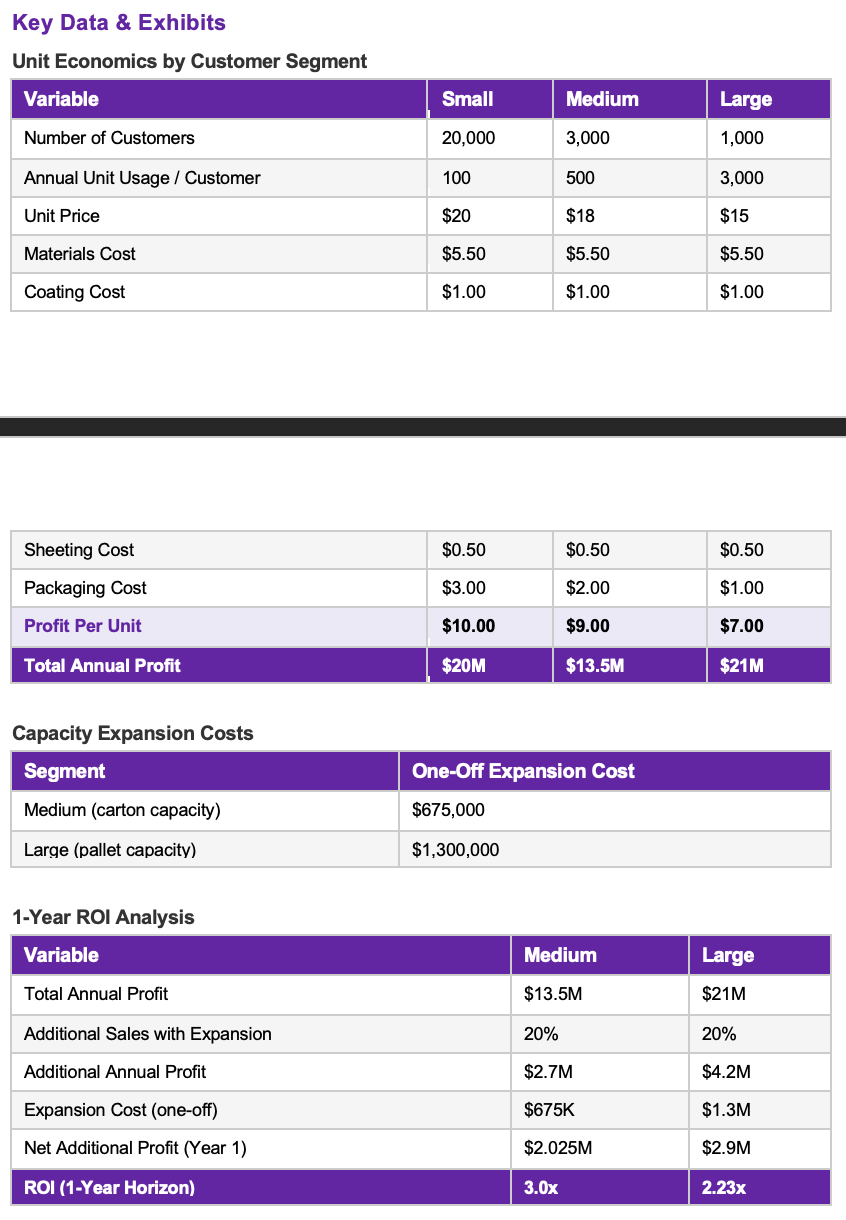
Structured Approach • Step 1 – Segment the market: Identify where growth opportunities exist. Given that market share is already high in small printers (30%) and the industry is mature, focus analysis on medium and large segments. • Step 2 – Calculate per-unit profitability: Subtract all variable costs (materials, coating, sheeting, packaging) from unit price for each segment. • Step 3 – Calculate total annual profit: Multiply unit profit by the number of customers and annual usage per customer. • Step 4 – Estimate the benefit of expansion: A 20% increase in sales is achievable in both medium and large segments if production is expanded. • Step 5 – Compare ROI: Divide net additional profit (after one-off capex) by the cost of investment for a 1-year horizon comparison. Key Insight The medium printer segment offers a superior 1-year ROI (3.0x vs. 2.23x) and requires lower upfront investment ($675K vs. $1.3M), reducing financing risk. Over a longer time horizon, the large segment eventually generates a higher absolute ROI — an excellent candidate will identify this crossover point. Recommendation • Invest in expanding carton (medium segment) capacity first. • Consider large segment expansion subsequently, depending on capacity and capital availability. • Explore downstream diversification given the maturity of the core specialty paper market. Key Risks • Growth assumptions assume a static market — competitive response is likely given industry maturity. • The 20% sales increase is an assumption from internal research and may not materialize. Next Steps • Develop an operational plan for production expansion and required timelines. • Assess competitive response risk from rivals. • Deep-dive into segment-level industry trends.
Practice Sessions
Note: Accepted practice sessions will be available in your profile under "My Practice Sessions".
Case Materials
Submissions (0)
Be the first to comment on this case.

Practice with AI
Sharpen your skills by practicing this case with our AI-powered consultant.
Practice Sessions
Note: Accepted practice sessions will be available in your profile under "My Practice Sessions".