
The Pricing Games
Practice with AI
Hone your skills by practicing this case with our AI-powered consultant.
Your client is Next Level Gaming (NLG), a start-up in the E-sports and computer gaming industry based in Los Angeles, California. NLG is planning to launch its first game – an online, multiplayer role playing game that is unlike any existing franchise. Being a new player in the industry, NLG’s CEO, Bobby Beck, has asked for your help in deciding its business model.
Your client is Next Level Gaming (NLG), a start-up in the E-sports and computer gaming industry based in Los Angeles, California. NLG is planning to launch its first game – an online, multiplayer role playing game that is unlike any existing franchise. Being a new player in the industry, NLG’s CEO, Bobby Beck, has asked for your help in deciding its business model. The company is considering 3 alternatives: a subscription model where players pay a monthly fee; a retail model where players pay full price at initial purchase, and a free-to-play model where the game is free to play but charges players for in-game merchandise. How would you advise NLG to proceed?
NLG's CEO Bobby Beck needs to decide which of three pricing models to launch with, in order to maximize long-term profitability and competitive positioning as a first-time entrant in a crowded market.
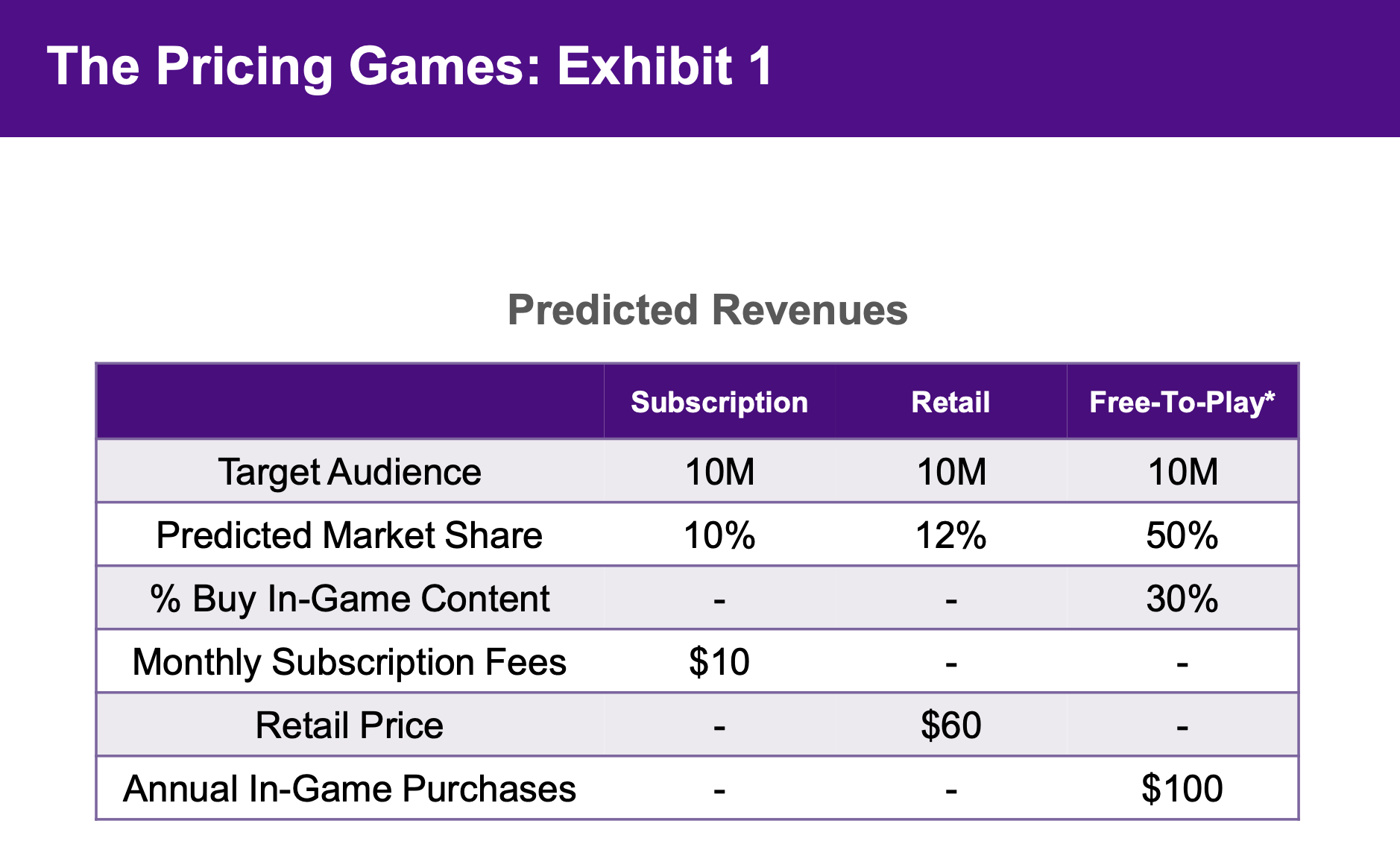
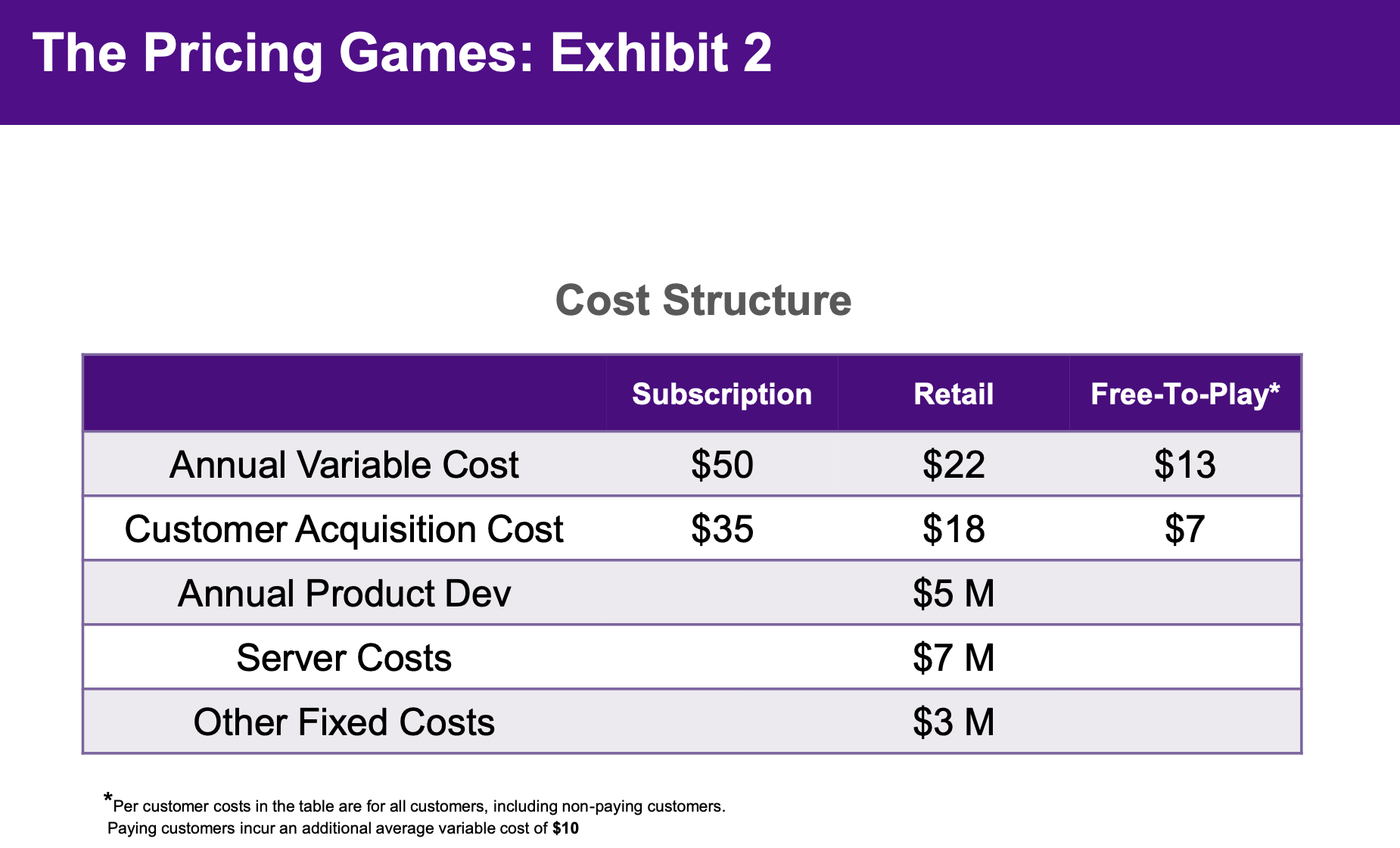
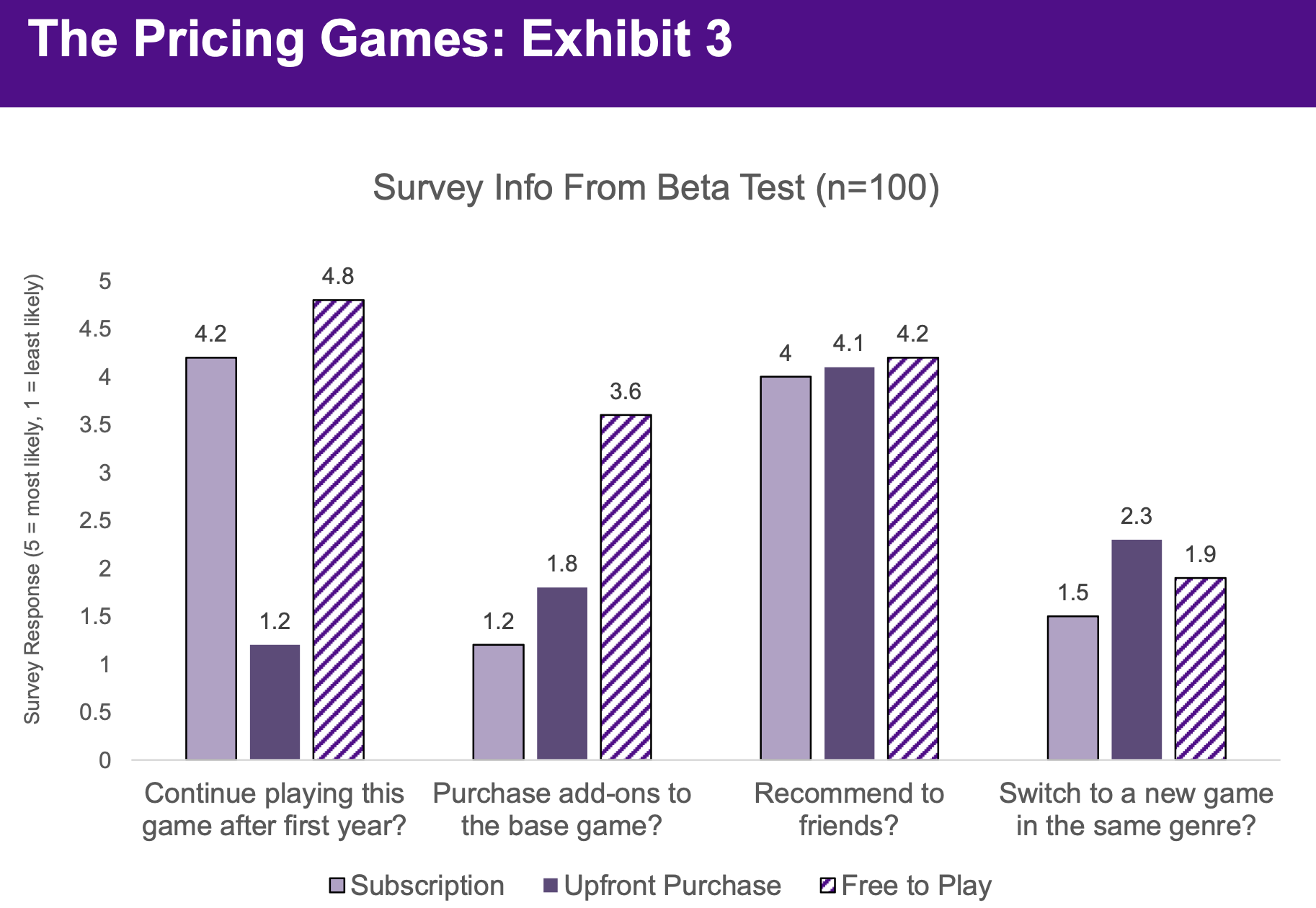
Opening framework should cover: profitability drivers for each model (players acquired × revenue per player, minus fixed and variable costs), qualitative factors (competitive response, retention, acquisition costs, ancillary revenue), and future expansion potential. For Q1, build a top-down market sizing by age cohort — apply computer ownership rates, gaming participation rates, and willingness to try a new genre. Target answer is ~10M players. For Q2, work through each model methodically: revenue = market × take rate × price, then subtract variable costs per user and shared fixed costs. Flag that the $10M R&D spend is sunk and irrelevant. Note the footnote in Exhibit 2 about the additional $10 variable cost for paying Free-To-Play users — missing this is a common error. For Q3, bucket your brainstorm cleanly: customer stickiness, competitive moats, growth vectors (mobile, console, international, sequels), and alternative monetization. Strong candidates bring up e-sports tournament hosting as a long-term upside. For Q4, the survey signals that retail has the weakest retention and lowest add-on potential, effectively eliminating it. Both subscription and free-to-play show strong loyalty. The recommended model is free-to-play — it captures the largest player base (50% market share), provides the strongest long-term competitive positioning, and enables future expansion. The key risk is converting enough free users to paying customers; mitigate by designing two distinct in-game purchase types targeting both aesthetic and progression-oriented players.
Practice Sessions
Note: Accepted practice sessions will be available in your profile under "My Practice Sessions".
Case Materials
Submissions (0)
Be the first to comment on this case.

Practice with AI
Sharpen your skills by practicing this case with our AI-powered consultant.
Practice Sessions
Note: Accepted practice sessions will be available in your profile under "My Practice Sessions".