
Large Pharma Co
Practice with AI
Hone your skills by practicing this case with our AI-powered consultant.
A large pharmaceutical company has developed a breakthrough daily pill (IPP2) that cures baldness by regrowing hair to its thickness at age 15. The pill must be taken daily to maintain results. The candidate must determine the optimal pricing strategy for IPP2. This is a classic pricing case that tests the candidate's ability to frame value-based pricing, segment customers by willingness to pay, and weigh pricing levers (launch price, insurance strategy, competitive positioning) against commercial objectives.
Our client is a large pharmaceutical company that has invested significantly in R&D to develop IPP2, a daily oral pill that regrows hair to its thickness at age 15. Key product characteristics: - Treatment duration: 3 months to achieve full regrowth. - Maintenance: the pill must be taken daily indefinitely to maintain results. - Efficacy: dramatically superior to existing treatments (e.g., minoxidil, finasteride) which only slow or partially reverse hair loss. - The drug has received regulatory approval and is ready for commercial launch. The client needs a pricing recommendation before launch. They have no prior pricing set.
Our client is a large pharmaceutical company that has developed a cure for baldness. The cure is a pill that will regrow your hair to the thickness that it was when you were 15. It takes just three months and must be taken daily to maintain results. How would you price this product?
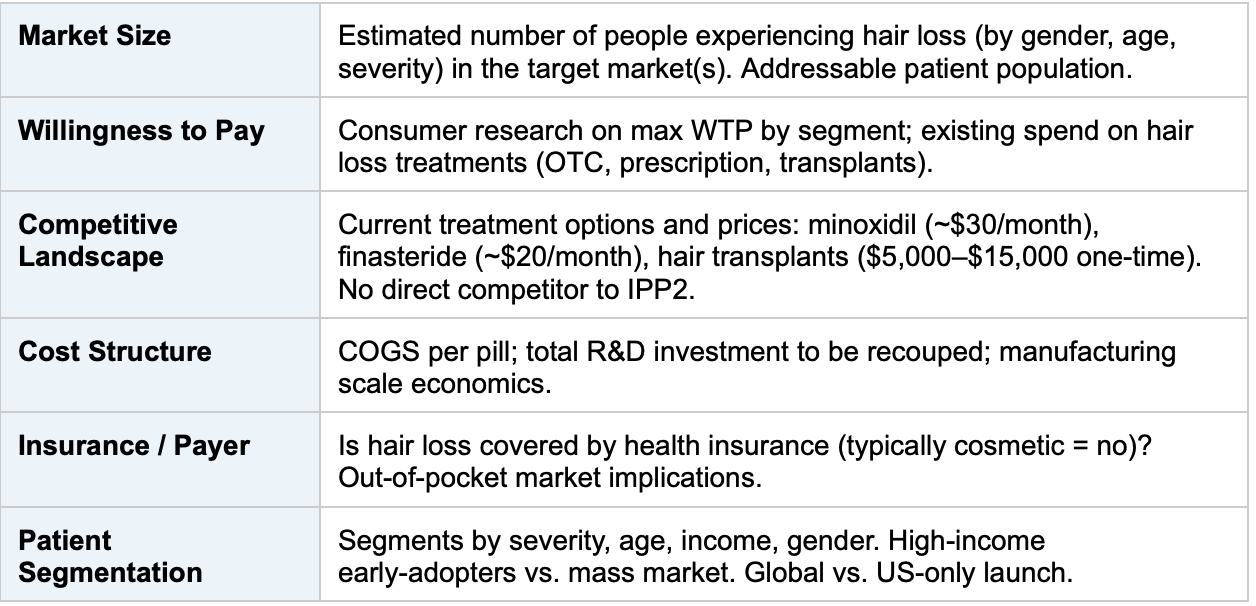
Step 1 — Establish Pricing Framework Anchor on value-based pricing: the price should reflect the value delivered, not just cost-plus. Identify three pricing anchors: (a) cost floor, (b) competitive ceiling vs. next-best alternative, (c) WTP ceiling from consumer research. Step 2 — Size the Value Delivered Hair transplant equivalent value: $5k–$15k one-time. IPP2 delivers superior, reversible results daily. If a patient values the outcome at ~$5,000 over 3 years, the implied monthly price is ~$140/month. Cross-check: at $100–$150/month, how does this compare to WTP research and current spend? Step 3 — Define Segmentation & Structure Consider a tiered model: premium price in high-income markets (US, UK, Europe); lower access price in emerging markets. Evaluate subscription vs. per-pill pricing — subscription improves adherence, reduces churn, and provides predictable revenue. Step 4 — Recommend Recommended price: $100–$150/month (out-of-pocket, US market) — premium to alternatives, below hair transplant amortised cost. Introduce a starter pack at a lower price point for the first 3 months to drive trial and demonstrate efficacy. Pursue insurance coverage lobbying as a longer-term strategy to access a broader patient base.
Practice Sessions
Note: Accepted practice sessions will be available in your profile under "My Practice Sessions".
Case Materials
Submissions (0)
Be the first to comment on this case.

Practice with AI
Sharpen your skills by practicing this case with our AI-powered consultant.
Practice Sessions
Note: Accepted practice sessions will be available in your profile under "My Practice Sessions".