
Fashion Co.
Practice with AI
Hone your skills by practicing this case with our AI-powered consultant.
A mid-market fashion retailer has experienced a sustained decline in revenues over the past five years. Bain has been engaged to identify the root causes of the decline and recommend a turnaround strategy. This case tests a candidate's ability to structure a profitability diagnosis, interpret market data, and prioritise strategic levers.
Fashion Co. is a mid-market clothing retailer operating 200 stores across North America, with an additional e-commerce channel that launched four years ago. The company primarily targets women aged 25–45 with a product mix of casual and office wear priced at the accessible-premium tier ($40–$120 per item). Over the past five years, total revenues have fallen from $1.2 billion to $900 million — a 25% cumulative decline. The broader mid-market apparel segment has grown at 2% per annum over the same period, suggesting company-specific rather than market-level drivers. - Revenue declined from $1.2B to $900M over 5 years (CAGR of -5.7%) - Market segment grew at ~2% p.a. during the same period - 200 physical stores (North America) + growing e-commerce channel - Target demographic: women aged 25–45, accessible-premium pricing - E-commerce launched 4 years ago; contribution not yet disclosed to candidate
Bain has been brought in to answer a fundamental strategic question: why has Fashion Co.'s revenue declined by 25% over five years while the broader market grew, and what actions should the company take to return to sustainable growth? The engagement must address: - Identifying whether the decline is volume-driven (fewer units sold), price-driven (lower price realization), or mix-driven (shift to lower-margin categories) - Determining whether the problem is internal (operations, product, brand) or external (competition, macro, shifting consumer behaviour) - Evaluating the performance of the e-commerce channel relative to the store network - Prioritising 3–5 strategic levers to stabilise revenues and return to growth within 18–24 months
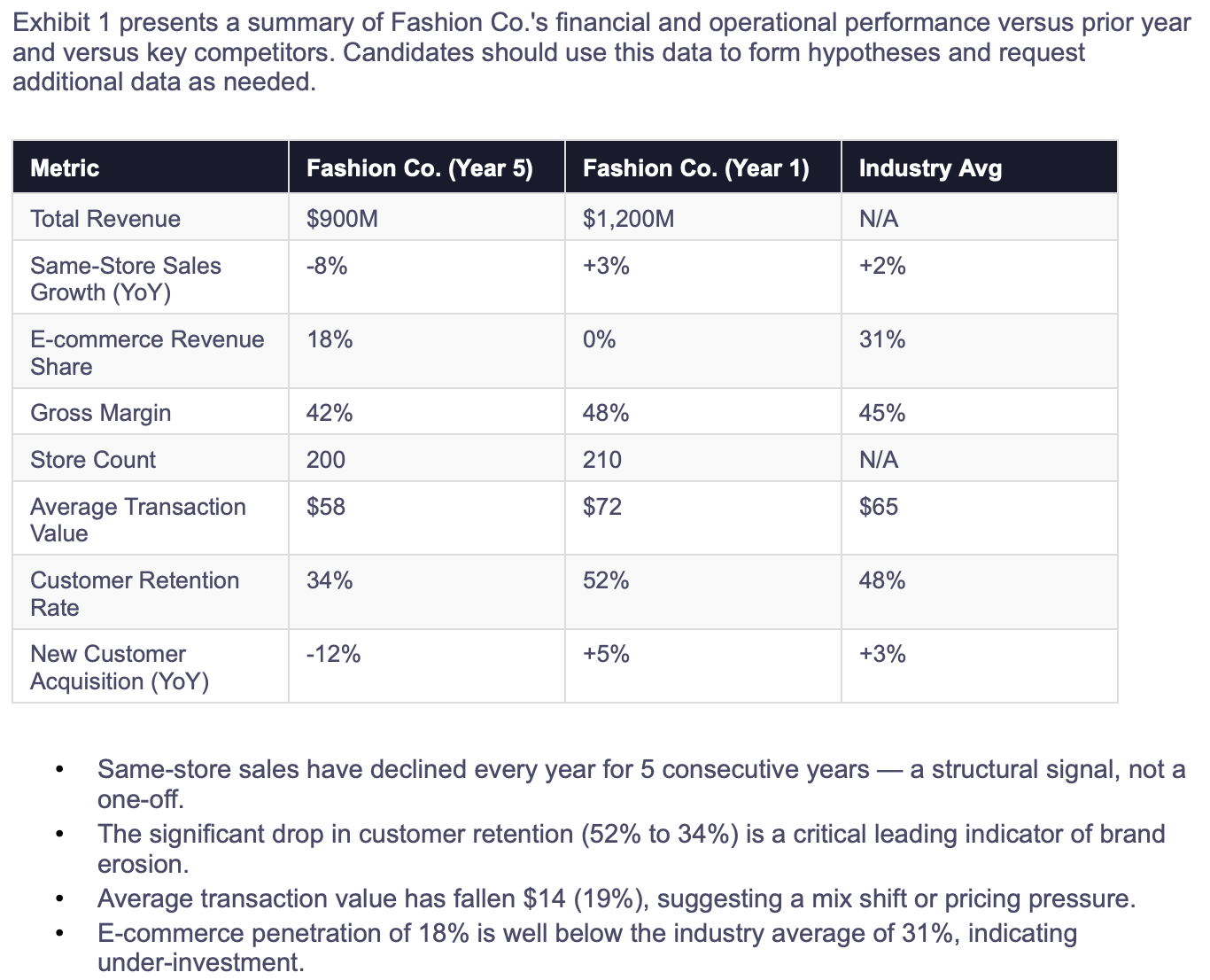
This is a classic profitability / revenue decline case. The recommended structured approach is to decompose the revenue decline, identify root causes, and prioritise actionable levers: Step 1: Decompose revenue — break total revenue into volume (units sold) × price (average selling price) × mix. Determine which driver accounts for most of the decline. Step 2: Assess the competitive environment — benchmark Fashion Co. against peers on brand positioning, product freshness, omni-channel capability, and pricing to identify gaps. Step 3: Diagnose customer dynamics — analyse acquisition vs. retention vs. reactivation metrics. The data shows a sharp retention decline, suggesting brand or product issues. Step 4: Evaluate the channel portfolio — the e-commerce underperformance is a clear opportunity; assess the investment required to close the gap with the industry average. Step 5: Identify root causes — synthesise findings into a clear cause-and-effect narrative (e.g., product relevance decline → lower repeat purchase → retention erosion → revenue fall). Step 6: Prioritise recommendations — frame 3–5 actions by impact and feasibility, with a 90-day quick-win plan and an 18-month transformation roadmap. A strong conclusion would identify product-market fit erosion and digital under-investment as the two primary root causes, and recommend: (1) a curated product refresh aligned with the target demographic's evolving preferences, (2) an accelerated e-commerce investment plan to reach 28–30% penetration within 24 months, and (3) a loyalty programme redesign to recover retention from 34% to at least 45%.
Practice Sessions
Note: Accepted practice sessions will be available in your profile under "My Practice Sessions".
Case Materials
Submissions (0)
Be the first to comment on this case.

Practice with AI
Sharpen your skills by practicing this case with our AI-powered consultant.
Practice Sessions
Note: Accepted practice sessions will be available in your profile under "My Practice Sessions".