
GGC Health
Practice with AI
Hone your skills by practicing this case with our AI-powered consultant.
Our client, GGC Health, operates eight Ambulatory Surgical Centers (ASC) on the east coast. GGC Health has consistently been a profitable organization, but over the past two years, their ASCs’ cumulative revenues have been flat at $400 million/year. The CEO of GGC Health is concerned about this and has hired your firm to increase revenues by 15%.
GGC Health operates eight Ambulatory Surgical Centers (ASCs) along the US East Coast. ASCs are modern healthcare facilities providing same-day surgical care, including diagnostic and preventive procedures, and are viewed as more convenient alternatives to hospital-based outpatient surgery. Physicians choose where to perform surgeries and generally dictate the setting. GGC Health has been consistently profitable, but cumulative revenues across all eight ASCs have been flat at $400 million per year for the past two years. The CEO has engaged a consulting firm to identify strategies to increase revenues by 15% ($60M target increase). Key business model note: ASC revenue = (Number of procedures performed) x (Reimbursement rate per procedure). Pricing increases are not available — growth must come from volume.
How can GGC Health increase cumulative revenues by $60M (15%) as quickly as possible? Options include increasing volume at existing sites and/or opening new ASC locations.
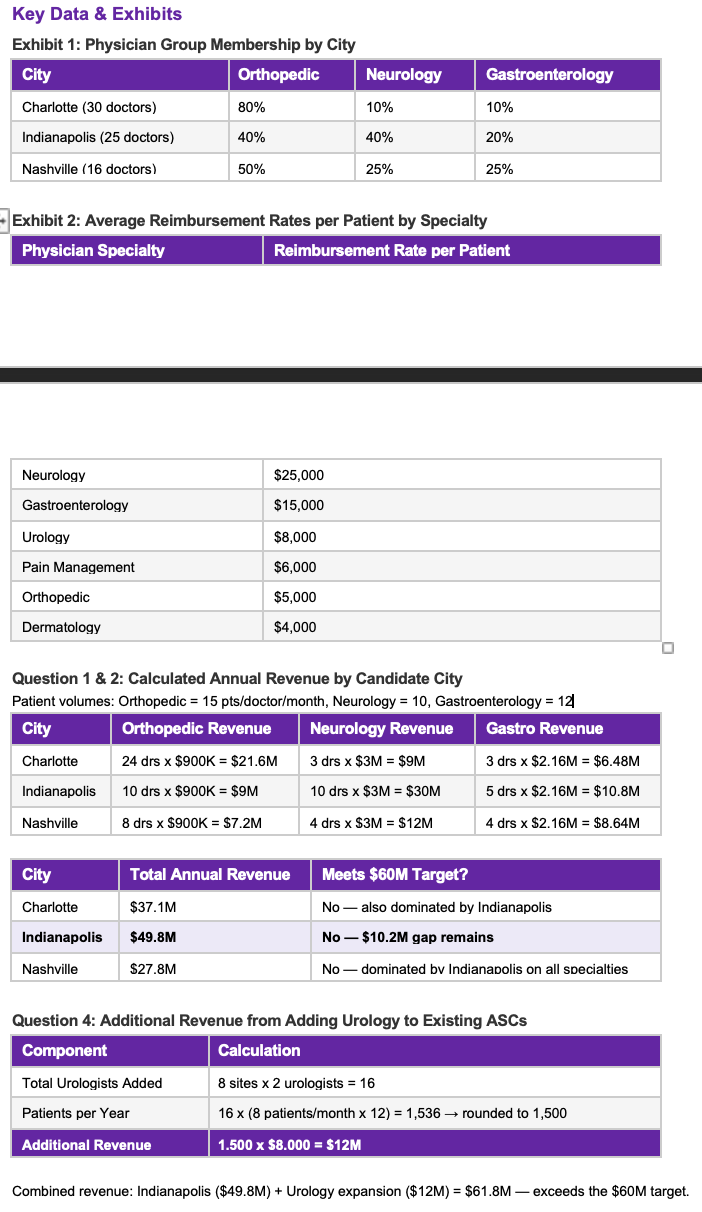
Framework for Growth Increase revenue at existing 8 ASCs: • Increase patients per doctor: Make ASCs more attractive to physicians through better scheduling, efficiency, environment, and profit-sharing incentives. • Increase number of doctors per ASC: Recruit physicians in new specialties (e.g., urology) and through active outreach. • Optimize product mix: Prioritize high-reimbursement specialties (neurology at $25K/patient vs. orthopedic at $5K). • Expand patient types: Evaluate acceptance of Medicaid/Medicare patients to access new patient pools. Expand via new ASC locations: • Analyze potential markets for physician group size, specialty mix, and reimbursement profiles. • Assess competitive landscape: existing ASCs and hospital strength in each market. • Consider regulatory environment and partnership opportunities with physician groups. City Selection Logic • Eliminate Nashville immediately — Indianapolis has more doctors in every specialty. • Indianapolis dominates Charlotte in total revenue ($49.8M vs. $37.1M) despite fewer total doctors — driven by its strong Neurology mix (high reimbursement). • Indianapolis is the clear choice for new ASC expansion. Recommendation • Open a new ASC in Indianapolis — projected to generate $49.8M in annual revenue. • Add 2 urology doctors per existing site (16 urologists across 8 ASCs) — projected to generate an additional $12M. • Combined, these two initiatives exceed the $60M revenue growth target. Key Risks • No costs have been modeled for new site construction or procedure additions — a full cost-benefit analysis is required. • Indianapolis is outside GGC's East Coast base — management may be less familiar with the market. • ASC capacity constraints may limit the ability to add new surgeries without infrastructure investment. • Physicians may bring fewer patients than projected. Next Steps • Conduct a full cost-benefit analysis for the Indianapolis expansion. • Begin credentialing and contracting for urology doctors at existing sites immediately. • Explore additional high-reimbursement specialties to add to the existing site portfolio. • Consider expanding into additional markets after Indianapolis is established.
Practice Sessions
Note: Accepted practice sessions will be available in your profile under "My Practice Sessions".
Case Materials
Submissions (0)
Be the first to comment on this case.

Practice with AI
Sharpen your skills by practicing this case with our AI-powered consultant.
Practice Sessions
Note: Accepted practice sessions will be available in your profile under "My Practice Sessions".